7 Best Enterprise AI Tools with Human-in-the-Loop Approval in 2026
We compared the top enterprise AI tools with human-in-the-loop approval workflows, covering how each handles escalation, audit trails, and the balance between automation speed and human oversight.
We compared the top enterprise AI tools with human-in-the-loop approval workflows, covering how each handles escalation, audit trails, and the balance between automation speed and human oversight.
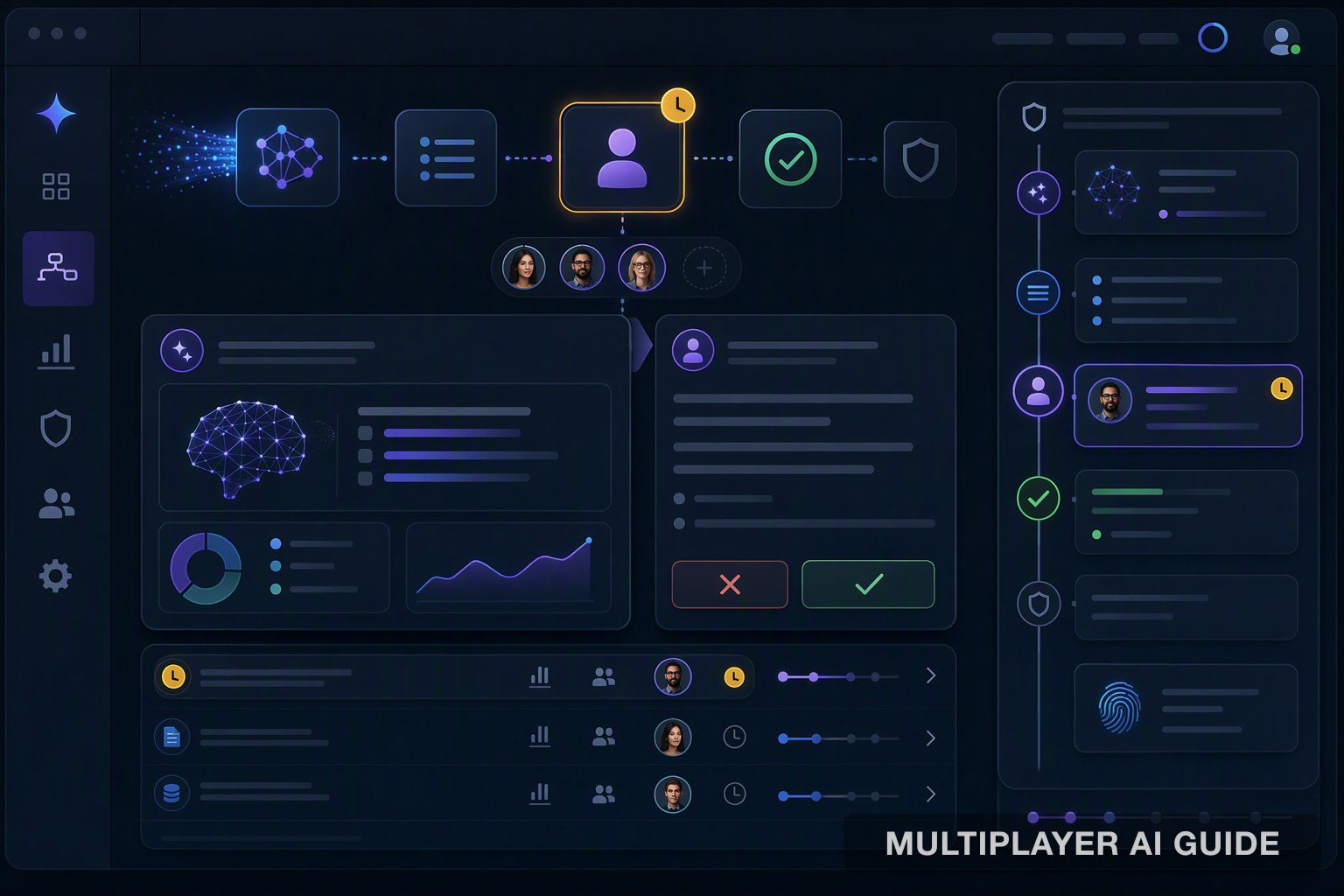
For years, the promise of enterprise AI felt like a lie. The expectation was a calculator: same input, same output, every time. What showed up instead was a brilliant but unreliable collaborator that could hallucinate in the middle of a board presentation. The problem was never that the models are bad, it's that the expectation of deterministic software was broken from the start. Enterprise AI is a shift from fixed-logic engines to probabilistic systems that explicitly model uncertainty, and the only sane organizational response is a hard gate: human-in-the-loop (HITL) approval.
This shift matters in 2026 because trust is no longer built on the guarantee of a fixed output. Trust is built on the transparency of the process and the robustness of the guardrails around it. Without a human stopping the machine before a high-stakes action, an organization is just praying the variance doesn't bite. The move is from the "calculator" expectation to the "collaborator" model, where the AI suggests and a human approves.
The spectrum spans two poles. On one end sit deterministic knowledge graphs and plan-based systems that structurally can't produce an ungoverned answer. On the other sit probabilistic agents that score their own uncertainty and pause when confidence drops, needing constant observability to know when to ask for help. In this article, we compare 7 enterprise AI tools that define these poles, from architectures that make hallucination structurally difficult to the observability and workflow layers that catch a probabilistic system before it acts.
Key Takeaways
The architecture tradeoffs in HITL enterprise AI come down to a few consistent patterns in 2026:
- Architectural dichotomy: The real choice is between probabilistic agents (LLMs that score uncertainty and pause for a human) and deterministic semantic backbones or plan-based systems (architectures that structurally resist hallucination rather than catching it after the fact).
- Uncertainty as a trigger: In probabilistic systems, a human doesn't review everything. The system stops itself when the uncertainty score spikes or a plan calls for a sensitive action, and asks for help at that specific moment.
- Deployment is a security boundary: Regulated data demands BYOC or a dedicated VPC. If the AI agent holds its own standing credentials, the approval gate has already failed, the gate needs to fire before data leaves the perimeter, not after.
- Planning overhead is a real cost, not a rounding error. Research on data-centric tool calling shows that agents which skip structured planning and call tools step-by-step consume meaningfully more tokens than agents that plan a full horizon upfront, a gap that compounds across multi-step workflows and directly affects both cost and review load.
What to Look for in an Enterprise AI Tool with HITL Approval
Before comparing specific platforms, these are the questions that actually determine whether an approval gate does its job:
- Does the architecture prevent bad outputs, or catch them after generation? A deterministic, plan-based system that can't produce an unauthorized action is a structurally different guarantee than a probabilistic model that gets reviewed after the fact.
- What actually triggers human review? A fixed percentage of random spot-checks is weaker than a system that pauses specifically when its own confidence drops or a sensitive action is about to fire.
- Where does the approval gate sit relative to the data perimeter? BYOC, single-tenant VPC, or on-prem deployment means the gate fires before data ever leaves a controlled boundary, not after it's already been exposed.
- Is the review tied to organizational authority, or just to whoever is available? Role-based approval routing prevents the wrong person, technically capable but organizationally unauthorized, from signing off on a decision.
- Can a reviewer actually see the reasoning, or just the final output? A visual lineage or an inspectable plan lets a human verify the path to an answer, not just the answer itself.
Best Enterprise AI Tools with Human-in-the-Loop Approval
The tools below are compared on the dimensions that matter most: whether they prevent bad outputs structurally or catch them reactively, and where the approval gate actually sits.
| Tool | Best For | Architecture | Approval Trigger |
|---|---|---|---|
| PromptQL | Deterministic plan-based approval before execution | Plan-based, deterministic | Explicit human step in the plan itself |
| Graphwise Platform | Regulated industries needing near-zero hallucination | Deterministic semantic backbone (knowledge graph) | Rarely triggered; wrong answers are structurally difficult |
| Arize AI | Observability for probabilistic agents already in production | Uncertainty scoring and semantic drift detection | Confidence drop or drift beyond a defined threshold |
| LangGraph | Custom-built, code-first HITL workflows | Stateful graph execution, developer-defined | Explicit "interrupt before tool" pattern |
| IBM watsonx Orchestrate | Role-based approval tied to a compliance suite | Bounded execution within policy constraints | Role-authorized reviewer required before action |
| Dataiku LLM Mesh | Approving multi-hop answers synthesized across silos | Governed connectivity with visual lineage | Reviewer inspects the full data trail, not just the summary |
| AWS Bedrock Agents | Teams needing network-level isolation, not just app-layer review | VPC-sandboxed execution, no standing agent credentials | Human is the sole egress point releasing results from the VPC |
With the landscape mapped out, here is how each tool works in practice.
1. PromptQL
PromptQL treats human approval as a literal step inside the plan, not a wrapper around it. When the system reasons through a query and reaches an action that needs sign-off, the plan pauses at that exact point, just the step requiring approval, not the whole workflow, while everything already executed or already approved stays intact.
Key features:
- Approval as a plan step: A human sign-off is one node in the same plan as the rest of the execution, so the system shows exactly what led up to the approval point and what happens immediately after, rather than a separate review dashboard disconnected from the reasoning.
- Selective, not blanket, approval: Only the specific action flagged as sensitive stops for review; the rest of the plan around it doesn't require separate sign-off, which keeps the gate targeted instead of turning every step into a checkpoint.
- Every approval is a logged event: Each human step becomes part of the audit trail, tied to the exact plan and action it gated, inside a customer's own VPC or on-prem deployment, not a generic "approved" timestamp disconnected from context.
Trade-off: This requires structuring the workflow as an explicit plan for a human step to attach to; a fully improvisational, freeform agent doesn't have a natural place to insert this kind of gate.
Best for: Teams that want the approval step to be inseparable from execution itself, not a dashboard reviewing outputs after the fact.
2. Graphwise Platform
Most HITL tools focus on building a faster review process. Graphwise does something different: it shrinks how often a human needs to be pulled in at all. Because every answer traverses a modeled graph of verified facts rather than predicting a token sequence, the approval question moves from "is this specific output safe to release" to "does the underlying graph correctly represent the business," a question answered once during modeling, not repeatedly at query time.
Key features:
- A smaller review queue by design: The taxonomy and ontology work happens upfront, before deployment, so most queries never reach a point where they'd need a human sign-off in the first place, the opposite of a system that generates first and reviews after.
- The traversal path is the approval artifact: When a query does need human eyes, a reviewer sees the specific chain of verified relationships that produced the answer, not a confidence score that still has to be interpreted.
- Review shifts from query-time to model-maintenance time: The meaningful human checkpoint becomes periodic review of the graph as the business changes, not an interruption inside every individual query.
Trade-off: This only works if someone keeps the semantic model current; a graph that drifts out of sync with the business reintroduces the exact review burden this architecture was built to avoid.
Best for: Regulated teams that would rather invest in getting the underlying model right once than build a review process to catch every individual output.
3. Arize AI
Arize AI answers a different question than most tools on this list: not "how does a human approve," but "how does the system know when to ask." It scores every output for confidence and tracks semantic drift against a baseline, so a review request fires exactly when uncertainty crosses a threshold, not on a fixed schedule that misses fast-moving problems or over-reviews stable ones.
Key features:
- Confidence-triggered review: A drop below a set threshold is what generates the request for human sign-off, not a percentage-based sampling rule that reviews outputs regardless of whether they actually need it.
- Drift as an early-warning signal: A response that's technically confident but has drifted from an established baseline still triggers review, catching the kind of silent degradation a pure confidence score would miss entirely.
- Decoupled from the execution layer: Sits alongside whatever system is actually running the agent, so the trigger logic isn't tied to one specific vendor's workflow engine.
Trade-off: Arize decides when a human should look, not what happens once they do; it needs to be paired with an actual approval workflow to close the loop.
Best for: Teams already running probabilistic agents in production who need a precise, threshold-based trigger for review rather than a fixed review schedule.
4. LangGraph
LangGraph doesn't ship a pre-built approval workflow, it gives the primitive for building exactly one: a graph that can halt mid-execution, hand the proposed next step to a human, and refuse to continue without an explicit yes.
Key features:
- Interrupt-before-tool: Execution pauses at a defined node, streams the proposed action and current state to a reviewer's interface built for that exact pattern, and resumes only on approval, not on a timeout or a silent default.
- Approval scoped to a single node: Only the interrupt point stops; upstream and downstream logic in the graph keeps running under the team's own rules for what needs a human and what doesn't.
- State is fully visible at the pause: A reviewer sees the actual graph state at that point, not a summary reconstructed after the fact.
Trade-off: Every interrupt point, retry, and fallback has to be defined by the team building on the framework; there's no default set of "this needs approval" rules to start from.
Best for: Teams that want to decide, node by node, exactly where an agent needs to stop and ask, rather than accepting a vendor's predefined approval points.
5. IBM watsonx Orchestrate
Most approval workflows treat any available reviewer as interchangeable. IBM watsonx Orchestrate doesn't: it routes a pending decision to whoever actually holds the organizational authority to approve it, and blocks the action if that specific authority isn't present.
Key features:
- Authority-matched routing: A pending approval routes to a reviewer whose role matches what's being approved, the same permission-aware model behind AI tools built for teams rather than individuals, closing the gap where someone technically capable approves something outside their remit.
- Policy-scoped triggers: What requires approval is defined against explicit operational policy, so the trigger condition is a business rule, not a confidence score or a hard-coded exception list.
- Audit trail tied to authority: The log captures not just that something was approved, but that it was approved by someone with the standing to approve it.
Trade-off: This depends on an organization's role structure being accurately modeled inside the platform; a stale or incomplete role map routes approvals to the wrong people just as easily as no routing at all.
Best for: Organizations where "who is allowed to approve this" is as important a question as "was this approved," particularly under a formal audit process.
6. Dataiku LLM Mesh
Approving an answer synthesized from six different systems is hard when the reasoning is invisible. Dataiku's LLM Mesh is built specifically for that moment: instead of a chatbot response to accept or reject, a reviewer gets the actual path the system took across every source it touched.
Key features:
- Visual lineage as the approval object: A reviewer inspects the connective path between sources, similar in spirit to what dedicated knowledge graph tools make explicit, not just the final synthesized answer, so approval means verifying the trail rather than trusting the summary.
- Built for analytical review, not conversation: The interface is designed around inspecting a data trail, a different task than approving a chat response, and built accordingly.
- Consistent approval standard across sources: The same review criteria apply regardless of which underlying LLM or data store produced a given piece of the answer.
Trade-off: The lineage view is most valuable specifically when an answer spans multiple systems; a single-source, single-model query doesn't generate the same reviewable trail.
Best for: Teams approving answers that get synthesized across multiple enterprise silos, where the connections between sources matter as much as the final number.
7. AWS Bedrock Agents
Most approval gates sit inside the application layer, a human reviews an output before the system logs it as approved. AWS Bedrock Agents moves that gate to the network itself: nothing produced inside the sandbox reaches the outside world until a human explicitly releases it.
Key features:
- Approval as the only path out: Results generated inside the VPC sandbox stay there until a human explicitly approves their release, a stricter data-control model than most AI tools apply by default, with no default path for output to leave without that step.
- No standing credentials to bypass the gate: The agent has no credentials of its own that could push data out through a different channel, so the human release step isn't just policy, it's the only viable exit.
- The boundary is the enforcement, not a rule: Approval isn't a check the system could theoretically skip under load or error; it's a network boundary that has to be crossed deliberately.
Trade-off: This requires real infrastructure work to configure the VPC boundary correctly, a network topology problem, not a workflow-configuration one, a different skill set than tuning an application-layer approval rule.
Best for: Teams that want the approval step enforced at the infrastructure level, where no code path bypasses it, rather than trusting an application to always check first.
How to Choose the Right Tool for Yourself
The right fit depends on where the architecture actually needs to intervene:
- Want the approval gate built into the plan itself: PromptQL, where a human step is a native part of execution.
- Need near-zero hallucination in a heavily regulated industry: Graphwise Platform, if the organization can maintain a semantic model.
- Already running probabilistic agents and need a real review trigger: Arize AI, paired with an actual approval workflow.
- Want full, code-first control over exactly where interruptions happen: LangGraph.
- Need role-based approval tied to an existing compliance suite: IBM watsonx Orchestrate.
- Approving answers synthesized across multiple data silos: Dataiku LLM Mesh, for the visible lineage.
- Need network-level isolation, not just application-layer review: AWS Bedrock Agents.
Most regulated deployments end up combining a deterministic or plan-based execution layer with an observability tool that watches whatever probabilistic components remain in the stack.
Conclusion
The difference between a deployment that runs clean and one that ends up in a boardroom post-mortem comes down to where you seat the human reviewer.
Invest on one path: you build a semantic foundation so tight the model has no room to hallucinate. Graphwise enables that kind of knowledge fortress, one where every answer traces back to governed facts, not a statistical guess.
Or you take the other path. You embrace what an LLM can do but lock it inside hard constraints. PromptQL's plan gates stop an agent before it executes a dangerous step. AWS's network isolation prevents a model from reaching systems it should never touch.
Either architecture only holds if the human is in the loop before high-stakes actions fire. Remove that checkpoint and you are betting against a failure mode you cannot afford to remediate in production.
HITL is not a backup layer. It is the gate that closes before a probabilistic system writes a check your business has to cash.
Frequently Asked Questions
What is human-in-the-loop AI for enterprise tools and why does it matter in 2026?
Human-in-the-loop (HITL) AI is an architectural pattern where a human reviewer must approve specific, high-stakes decisions before the AI executes them. In 2026, it matters because probabilistic models that produce variance and hallucinations are dominant. HITL replaces the old 'calculator' expectation with a 'collaborator' model, managing the risk of inconsistent outputs.
Which enterprise AI platforms offer the most strong human-in-the-loop approval workflows?
Robustness varies by architecture. PromptQL offers native plan-based approval gates ('Human step'). LangGraph provides a code-first 'interrupt before tool' pattern. IBM watsonx embeds role-based approval in a compliance suite, while AWS Bedrock Agents use VPC isolation where the human acts as the egress point.
How does human-in-the-loop AI improve compliance, accuracy, and security in regulated industries?
HITL improves compliance by creating an audit trail for every gated decision, often tied to specific user permissions. It bolsters security by preventing autonomous agents from taking destructive actions, and it improves accuracy by pairing the system's speed with human judgment specifically when models flag high uncertainty.
What are the key architectural differences between deterministic plan-based execution and probabilistic agentic approaches for enterprise AI?
Deterministic plan-based execution (like PromptQL or Graphwise) generates a complete 'plan' upfront using knowledge graphs or fixed schemas, guaranteeing consistent outputs. Probabilistic agentic approaches (like standard LLM agents) generate the most likely next step on the fly, requiring uncertainty scoring and HITL to manage variance.
What deployment models are critical for enterprise HITL AI and how do they affect data residency?
Bring Your Own Cloud (BYOC), single-tenant Virtual Private Cloud (VPC), and on-premises deployments are critical. They ensure data never leaves the customer's controlled environment during model inference and sandboxed code execution. This makes the HITL approval gate the final controlled exit point for data leaving secure infrastructure.
How is enterprise HITL AI priced and what should buyers compare across tools in 2026?
Pricing is highly fragmented. Probabilistic tools often charge per input/output token plus per-seat fees for HITL reviewers. Deterministic platforms may charge per query or graph node. Buyers must calculate the hidden cost of token waste from unplanned agent loops, not just the base subscription or API rate.
Sources
Last verified: 2026-09-08