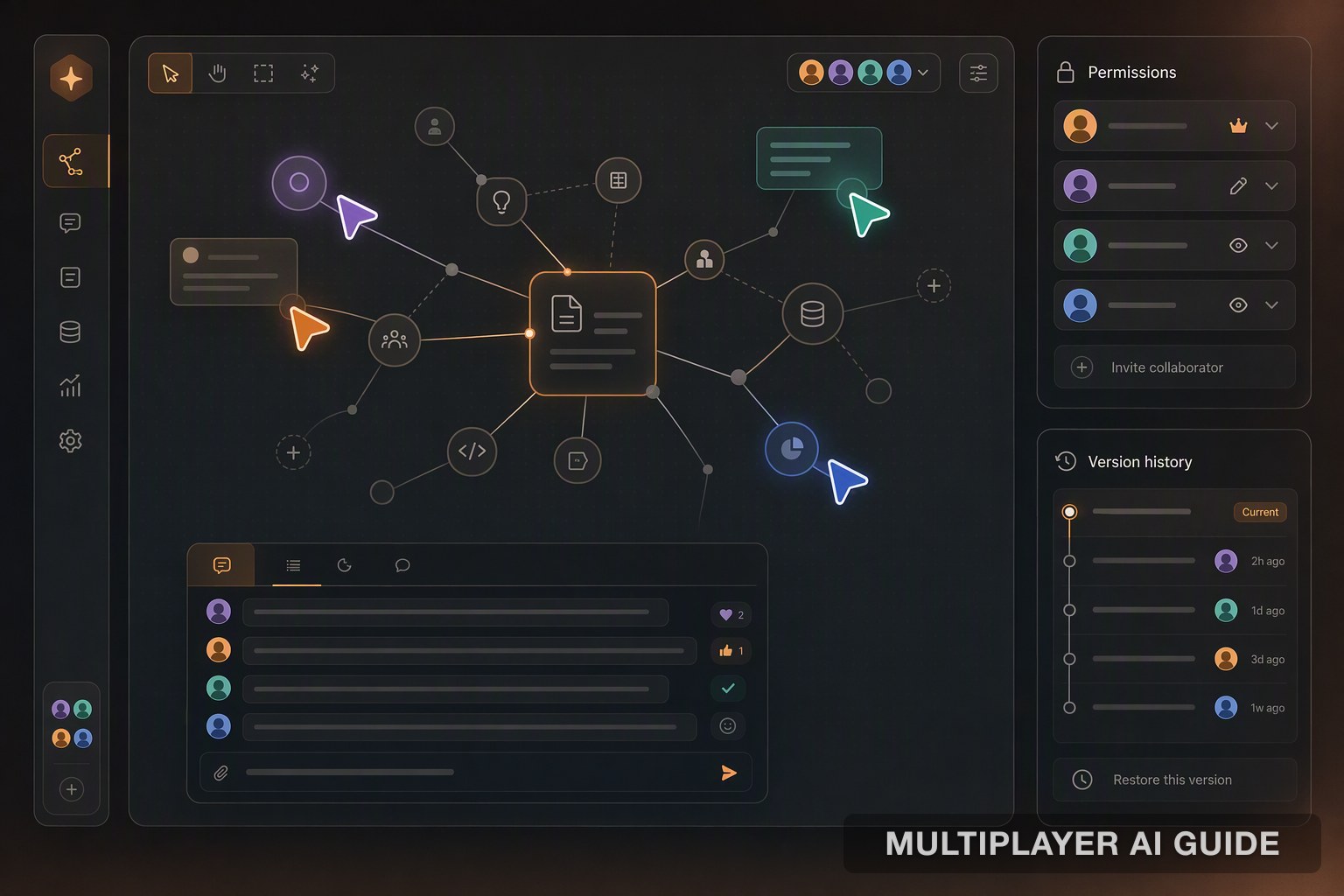
Best Multiplayer AI Tools for Team Collaboration
Four multiplayer AI tools built for teams rather than individuals: PromptQL (shared wiki with auditable reasoning, corrections compound automatically, GDPR and ISO 27001, runs in your own cloud), Coworker AI (OM1 organizational memory layer, 50+ native connectors, self-serve at $30 per user per month), Gumloop (no-code workflow builder with SOC 2 Type II governance, build once and share team-wide, enterprise customers include Shopify and Instacart), and StackAI (visual builder bridging fast prototyping with IT-grade governance including RBAC, audit logs, and on-prem deployment). Most AI tools still work like a personal assistant: one person, one thread, every fix locked inside whoever built it.
Most AI tools still work like a personal assistant: one person, one thread, and every fix or workflow locked inside whoever happened to build it. These four are built differently. Each treats team memory as the actual product, not a feature someone bolted on after the fact.
Most AI tools still work the way a personal assistant does: one person, one thread, one private history. That's fine for individual productivity, but it means every fix, every workflow, and every hard-won piece of context stays locked inside whoever happened to build it. A new hire joins, opens the same AI tool, and starts from zero, even though a teammate solved the exact same problem last month.
Multiplayer AI is the shift away from that. This guide compares the strongest tools built for teams working with AI together, not just individuals working alongside it.
What "multiplayer AI" actually means
Multiplayer AI works with several people inside shared, permission-governed context, not just a private, one-person-at-a-time thread. A shared workspace or a shared billing plan isn't the same thing as shared understanding, plenty of tools let a team pay for seats together while every person's history, corrections, and workflows stay siloed to them individually.
A few things actually separate genuine multiplayer AI from AI with a sharing button bolted on:
- Persistent, shared memory. What one person teaches the system should be available to the whole team automatically, not something they have to manually export or explain to a colleague.
- Permission-aware behavior. Access should follow the person actually asking, not a shared, all-purpose identity that can see everything regardless of who's behind it.
- Compounding, not resetting. A fix or a built workflow should make the whole team smarter over time, rather than staying trapped in one person's private history until they think to share it.
Best multiplayer AI tools for teams
| Tool | Primary strength | Shared memory model | Governance | Best for |
|---|---|---|---|---|
| PromptQL | Agentic semantic layer with a self-improving shared wiki | Corrections and context compound automatically as the team works | GDPR and ISO 27001, dedicated VPC or bring-your-own-cloud | Teams that want shared, auditable answers grounded in real data |
| Coworker AI | OM1 organizational memory layer | Persistent shared brain across the team, not a personal assistant | Native connections across 50+ tools | Non-technical teams that want organizational memory out of the box |
| Gumloop | Agents and workflows built by one person, shared across the team | Sharing is explicit, employees publish workflows for colleagues to use | SOC 2 Type II, GDPR, VPC deployment option | Teams where workflow sharing is the main collaboration pattern |
| StackAI | Bridges fast prototyping with enterprise governance | Shared app library with role-based access | RBAC, audit logs, SSO, SOC 2/HIPAA/GDPR on enterprise plans | Teams that need IT sign-off before deploying AI broadly |
1. PromptQL
PromptQL is built around a simple premise: a correction one person makes should stick for the whole team, not just for them. Instead of each person maintaining their own private AI history, a team works together in shared threads, and the context that comes out of that work becomes something everyone draws on afterward.
How it works: Questions get answered by planning against a team's actual connected data, Slack, Google Docs, Snowflake, Salesforce CRM, rather than a static, personal memory. PromptQL builds a shared wiki as the team works, capturing corrections, revision history, and a full audit trail automatically, and it runs in a team's own cloud, with enterprise plans offering a dedicated VPC or bring-your-own-cloud option.
Strengths:
- Corrections and context compound automatically, so the same mistake doesn't get made twice by two different people
- Permissions follow the actual person asking, not a shared bot identity with broad access
- Independently listed as built for GDPR and ISO 27001:2013 compliance
Limitations:
- Requires connecting and configuring real data sources rather than working out of the box against a demo
- Built around teams working with real, connected data, not a lightweight, casual personal assistant
2. Coworker AI
Coworker AI's defining feature is its OM1 organizational memory layer, a persistent, shared brain that stays with the team rather than resetting with every new conversation.
How it works: The OM1 layer builds a living knowledge graph across a wide range of dimensions, mapping relationships between people, accounts, and decisions, so agents get pre-synthesized understanding rather than starting from raw document retrieval each time. Coworker AI connects natively across more than 50 tools, including the usual stack of Slack, Salesforce, and Google Workspace, and pricing runs around $29.99 per user per month with self-serve onboarding.
Strengths:
- Organizational memory is built in from the start, not something a team has to configure or build themselves
- Fast to get running, with self-serve onboarding rather than a lengthy implementation project
- Predictable, transparent pricing that scales cleanly across a growing team
Limitations:
- Less suited to teams whose primary need is deep, auditable reasoning over structured data specifically
- A newer entrant relative to more established enterprise search and workflow platforms
3. Gumloop
Gumloop's version of multiplayer is explicit and workflow-driven: one person builds an agent or automation, and the rest of the team can pick it up and use it, creating a compounding effect as adoption spreads.
How it works: A visual, drag-and-drop builder lets someone without an engineering background construct multi-step workflows that pull live data, reason across it, and write results back into connected tools. Gumloop is SOC 2 Type II and GDPR compliant, with deployment available on its own secure infrastructure or inside a customer's own VPC. Real, verified enterprise customers include Shopify, Instacart, Gusto, Ramp, and Samsara, with Instacart alone scaling to over 1,000 users on the platform.
Strengths:
- Genuinely no-code, so workflow-building isn't limited to an engineering team
- Once someone builds something useful, colleagues can adopt it directly rather than rebuilding it themselves
- Real enterprise governance (SOC 2, GDPR, VPC) backing what's otherwise a fast, accessible builder
Limitations:
- Sharing is opt-in and workflow-by-workflow, rather than a continuously compounding shared memory the way PromptQL's wiki works
- Best suited to teams whose collaboration pattern is really "build once, share the workflow," not ongoing, live shared reasoning
4. StackAI
StackAI exists to close the gap between an AI tool a team loves and one IT will actually approve. It gives teams a visual builder for fast prototyping, paired with the governance features that get an application past a security review.
How it works: Pre-built components accelerate the path from a proof-of-concept to something deployable, while role-based access control, audit logs, and SSO give an infosec team what they typically need to sign off. Enterprise plans include on-prem and VPC deployment options alongside SOC 2, HIPAA, and GDPR compliance.
Strengths:
- Meaningfully shortens the distance between a working prototype and something a team can actually deploy company-wide
- Governance features are built in from the start, rather than requiring a separate security layer to be added later
- Solid third-party reception, with strong ratings on independent review platforms
Limitations:
- More of an AI application builder with team governance than a continuously shared, live collaborative memory
- Best fit for teams that specifically need the prototype-to-production bridge, rather than teams looking for out-of-the-box shared memory
How to choose
The right pick depends less on raw feature count and more on what kind of collaboration a team actually needs, continuously shared memory, explicit workflow sharing, or a governed path from prototype to production. A few starting points:
- Want shared, auditable answers that compound automatically as the team works with real data: PromptQL
- Want organizational memory out of the box, with minimal setup: Coworker AI
- Want a no-code way for anyone to build and share agents across the team: Gumloop
- Need a governed bridge from fast prototyping to something IT will approve: StackAI
Conclusion
The real difference between these four isn't which one has the most integrations, it's how each one actually treats team memory. PromptQL and Coworker AI build shared context in automatically as a team works. Gumloop treats sharing as something explicit, one person builds, the team adopts. StackAI focuses less on shared memory and more on getting a team from a promising prototype to something secure enough to run broadly. Pick based on which kind of collaboration is actually missing from how the team works today.
Frequently Asked Questions
What is prompt engineering in the context of AI agents?
Prompt engineering for agents goes beyond crafting a single query. It means designing the planning prompts, tool-use instructions, and reasoning steps that guide an autonomous system through multi-step tasks. A platform like PromptQL lets you guide behavior with a planning prompt that structures how the agent decomposes a request.
What are the best AI agent tools for teams in 2026?
The best tools split into two categories. Turnkey platforms like Coworker AI ($30/user/month), Gumloop, and StackAI offer pre-built agents and organizational memory. For developer teams that want maximum control, open-source frameworks like CrewAI and LangChain are the standard choices.
How does PromptQL compare to other AI development platforms for enterprises?
PromptQL differentiates with an agentic semantic layer that maps natural language directly to your data schema, rather than relying on vector similarity search. It is also deployed inside your own cloud, which matters for teams with strict on-premise or BYOC requirements.
What features should teams look for in a secure, on-premise AI agent for data analysis?
Look for deployment inside your own cloud with no raw database credentials exposed to the AI. The non-negotiable pillars of a secure on-premise agent include: - Deployment inside your own cloud with no raw database credentials exposed to the AI - Role-based access control to lock down data access by user - Audit logs to track every action taken by the agent - SSO integration for centralized identity management - Data-grounding architecture (as PromptQL does) that grounds answers in your actual data structures
How can enterprise teams measure the ROI and success of an AI agent pilot?
Enterprise AI pilots fail when success is not defined in dollars. Measure pilot effectiveness with these leading indicators: - Time saved per task measured against the previous process - Reduction in data query requests sent to engineering - Accuracy rates validated through human review - Speed ofproof-of-concept-to-productiontransition as a leading indicator the pilot is working
How does an agentic semantic layer improve accuracy and trust in AI-generated answers?
Instead of matching a question to semantically similar document chunks and hoping the answer is buried inside, an agentic semantic layer maps the query to the company's actual data schema. The LLM plans the retrieval, but the final answer is grounded in known, structured data, which eliminates extraction and reasoning errors.
Last verified: 2026-08-17