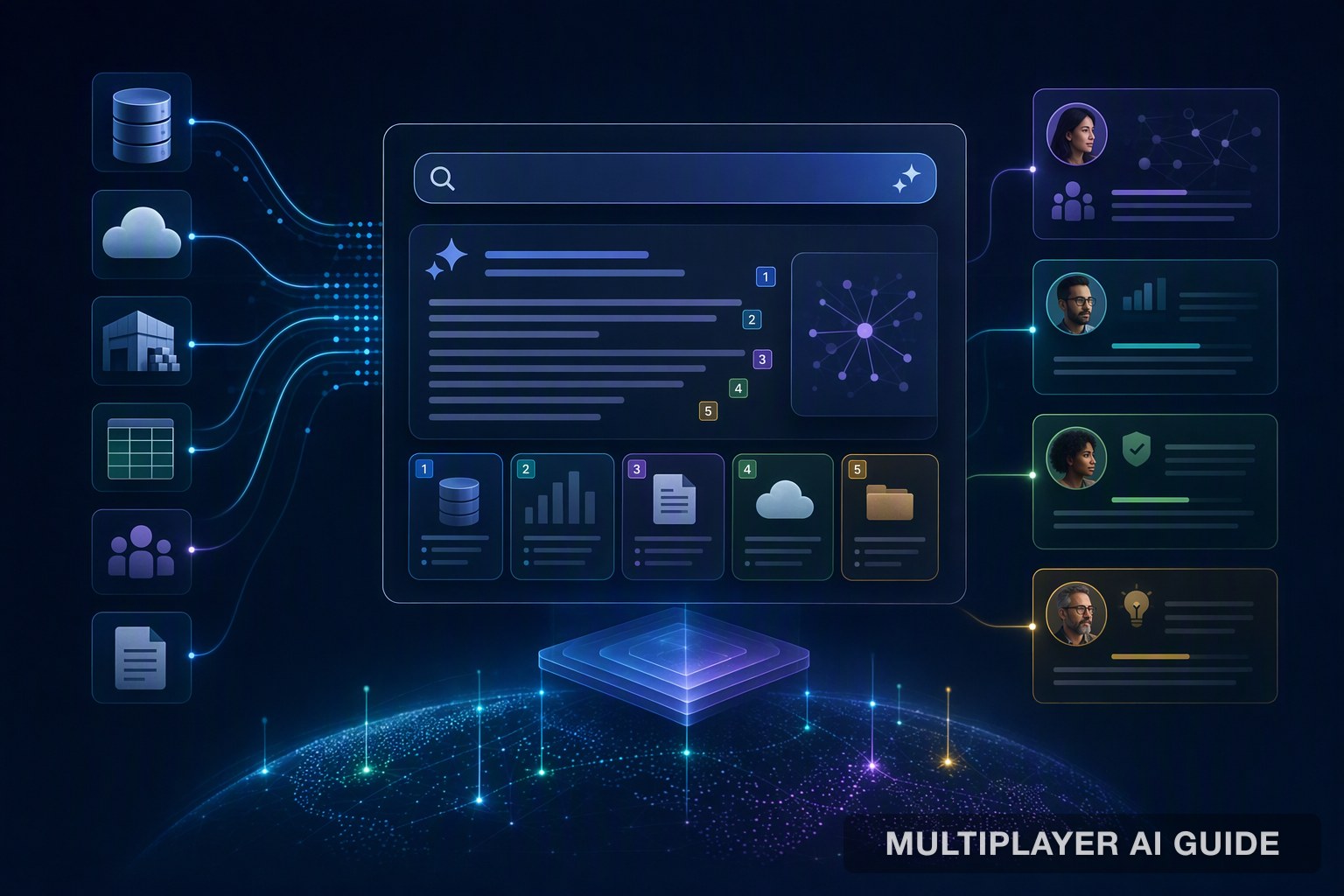
7 Best Perplexity Enterprise Alternatives in 2026
We compared the top Perplexity Enterprise alternatives for 2026, covering live data grounding, team knowledge integration, source citation quality, and which platforms work for teams that need more than web search.
We compared the top Perplexity Enterprise alternatives for 2026, covering live data grounding, team knowledge integration, source citation quality, and which platforms work for teams that need more than web search.
Perplexity Enterprise earned its reputation honestly. It pulls live data from across the web for every query, attaches numbered citations back to the original sources, and lets a user dig into Academic, Reddit, or YouTube-specific focus modes to narrow the search. Pro Search adds deeper, multi-step reasoning for harder questions, and the whole experience is fast enough that a team can go from question to a cited answer before a traditional search would have loaded ten blue links. For fast, cited exploration of the open web, it's genuinely strong, Gartner Peer Insights lists it among 12 rated alternatives in the enterprise AI assistant category, a sign of how seriously the market takes it.
The gap shows up once the question isn't "what does the web say" but "can this answer survive a compliance review." Perplexity Enterprise is cloud-only, with no BYOC, VPC, or on-prem option. It stores queries for product improvement by default. And its citation model, while genuinely useful for verification, isn't the same thing as a replayable, permission-aware audit trail, a citation shows where an answer came from; it doesn't show who was authorized to see the underlying data, or log every step the system took to get there.
In this article, we compare 7 Perplexity Enterprise alternatives, starting with PromptQL for teams that need deterministic, auditable answers on their own governed data, then moving through the generalist, ecosystem-native, and specialist options that compete more directly with Perplexity's own search-first approach.
Key Takeaways
The 2026 enterprise market has matured past the point where you must trade accuracy for speed. A few realities stand out:
- Deployment control is the dividing line. Perplexity Enterprise is cloud-only. Several alternatives now offer BYOC, single-tenant VPC, or on-prem options, a real requirement for regulated teams, not a nice-to-have.
- Citations aren't an audit trail. A source link shows where text came from; it doesn't show who accessed what data, under which permissions, or log the full reasoning chain the way a deterministic, plan-based system does.
- Data handling policy varies sharply. Perplexity stores queries for product improvement by default. Kagi stores zero queries. ChatGPT Enterprise commits that enterprise prompts aren't used for training. That spread matters for anything sensitive.
- Use-case alignment beats a single "best" tool. Developer teams gravitate toward Phind; Microsoft shops default to 365 Copilot; regulated industries need a deterministic, governed platform more than they need broader web coverage.
What to Look for in a Perplexity Enterprise Alternative
Before comparing specific tools, these are the questions that actually predict whether a switch solves the underlying problem:
- Can it deploy somewhere other than the vendor's cloud? BYOC, VPC, or on-prem options matter for regulated industries and for anyone who needs data residency control Perplexity doesn't offer.
- Is there a real audit trail, or just citations? Citations show a source. An audit trail shows who queried what, under which permission set, and every step the system took to produce the answer.
- How is data handled after a query runs? Stored for product improvement, excluded from training, or never stored at all are three very different privacy postures.
- Does it integrate with systems already in place, or add a new silo? An ecosystem-native tool (Microsoft Graph, Google Workspace) can outperform a standalone search layer for teams already committed to that stack.
- Is the use case general research, or something narrower? Developer-specific and long-document-specific tools often outperform a generalist search engine on their home turf.
Best Perplexity Enterprise Alternatives
The table below maps the dimensions that actually surface in a procurement conversation: deployment model, governance approach, and what each tool optimizes for.
| Tool | Best For | Deployment | Governance Approach |
|---|---|---|---|
| PromptQL | Regulated teams needing deterministic, auditable answers | BYOC, single-tenant VPC, or on-prem | Row/column permissions, immutable audit trail |
| ChatGPT Enterprise | Generalist productivity with strong collaboration | Cloud-only | Enterprise data not used for training |
| Microsoft 365 Copilot | Teams already living in Teams, Outlook, and SharePoint | Cloud-only, Microsoft ecosystem | Inherits existing Microsoft compliance boundaries |
| Claude Enterprise | Long-document analysis, legal and compliance review | Cloud-only | Constitutional AI training, public model card |
| Google Gemini for Workspace | Teams already on Google Cloud, Workspace, and BigQuery | Cloud-only, Google ecosystem | Region-locked data residency in Google Cloud |
| Phind | Developer-specific technical research | Cloud-only | Standard cloud governance, no deterministic audit trail |
| Kagi Enterprise | Privacy-absolute research with zero query storage | Cloud-only | Zero query storage, ad-free, subscription-funded |
With the landscape mapped out, here is how each option works in practice.
1. PromptQL
Perplexity Enterprise is built to answer "what does the web, or a connected source, say about this." PromptQL is built to answer a different, harder question: "can you show me exactly which row this number came from, and prove nobody unauthorized touched it along the way."
Where Perplexity retrieves and cites from the open web plus whatever's connected, PromptQL executes deterministic, plan-based queries directly against a team's own governed data infrastructure, flagging ambiguity explicitly rather than guessing at intent. A citation points to a source; PromptQL's audit trail logs every read, every permission check, and every output, a chain of custody a black-box search engine simply can't replay.
Key features:
- Plan-based execution: Flags ambiguous intent explicitly instead of guessing, producing an inspectable plan before any query runs.
- Permission-enforced queries: Every query runs under the requesting user's own permissions at the row and column level, inherited from existing systems, so two people with different access see different answers to the identical question with no query changes required.
- Enterprise deployment: Runs inside a customer's own cloud, including single-tenant VPC or fully on-prem, the same deployment-control territory covered by database-connected AI agent tools, so data stays on infrastructure the customer controls and raw database credentials never touch the AI.
- Immutable audit trail: Every read, side-effecting action, and output lands in an audit log a GRC team can hand directly to an auditor.
Best for: Regulated teams that need a verifiable, row-level chain of custody behind every answer, not just a link to where the text came from.
2. ChatGPT Enterprise
ChatGPT Enterprise is OpenAI's business tier of ChatGPT, adding admin controls, unlimited high-speed access to its most capable models, and a set of collaboration and connector features layered on top of the consumer product.
Where Perplexity is purpose-built around search-and-cite, ChatGPT Enterprise is a broader generalist with strong collaborative editing, native code execution, and API connectivity, trading Perplexity's search specialization for breadth across an entire workday.
Key features:
- Multiplayer Canvas: Real-time collaborative editing lets a team co-write analysis, reports, or code inside a shared workspace that tracks contribution, the same instinct behind AI tools built for teams rather than individuals.
- API connectivity and code execution: Connects to internal tools and can safely execute code in a sandboxed environment, turning natural-language requests into operational outputs.
- Data privacy guarantee: OpenAI commits that enterprise prompts and data are not used for model training.
- Strong peer validation: Carries a 4.6-star aggregate on Gartner, outperforming Perplexity specifically on evaluation/contracting and integration.
Best for: Teams that want one versatile tool for writing, coding, and research together, not just a search interface.
3. Microsoft 365 Copilot
Microsoft 365 Copilot embeds AI directly into Word, Excel, PowerPoint, Teams, and Outlook, grounding its answers in Microsoft Graph rather than the open web.
Where Perplexity draws its answers from the open web, Copilot grounds everything in Microsoft Graph, a team's own emails, chats, and documents, trading Perplexity's web breadth for deep, native integration inside applications already in daily use.
Key features:
- Native Graph grounding: Answers reflect internal reality (emails, chats, documents) rather than the public web, the same unified-search problem enterprise search tools like Glean are built to solve, with no separate retrieval pipeline to build.
- In-app automation: Triggers automated workflows from plain English directly inside Excel, Word, or a Teams chat.
- Inherited compliance boundary: Enterprise data protection rides on a customer's existing Microsoft compliance setup, with no new procurement lift required.
- Established peer rating: Carries a 4.3-star aggregate on Gartner, reflecting strong adoption inside Microsoft-native organizations specifically.
Best for: Organizations already standardized on Teams, Outlook, and SharePoint who want zero-switching-cost AI adoption.
4. Claude Enterprise
Claude Enterprise is Anthropic's business tier of Claude, built around a large context window, strong long-form reasoning, and a safety architecture Anthropic calls Constitutional AI.
Where Perplexity optimizes for fast, cited web research, Claude Enterprise optimizes for depth, a 1 million token context window that can hold entire contract suites or regulatory filings in a single pass, trading real-time web breadth for analytical depth on long, complex documents.
Key features:
- Extended context window: Current Claude models support up to 1 million tokens, enough to cross-reference hundreds of pages in one session without chunking or retrieval loss.
- Constitutional AI training: Reduces harmful outputs through a codified rulebook rather than post-hoc filtering, giving compliance teams a concrete document to audit against.
- Disclosed governance posture: A public model card, disclosed safety evaluation methodology, and an explicit commitment that enterprise data isn't used for training.
- Depth over breadth: Doesn't match Perplexity's real-time web search breadth, but wins decisively the moment the task is analyzing thousands of pages of discovery with a paper trail attached.
Best for: Legal, M&A;, and policy teams that need to cross-reference hundreds of pages in a single session with a disclosed, auditable safety methodology behind the model itself.
5. Google Gemini for Workspace
Google Gemini for Workspace brings Google's Gemini models directly into Gmail, Docs, Sheets, Meet, and Drive, with additional connectivity into BigQuery and Vertex AI for teams already running on Google Cloud.
Where Perplexity is a standalone search layer, Gemini is embedded directly inside Gmail, Drive, Meet, and Sheets, with native BigQuery and Colab connectivity, trading Perplexity's tool-agnostic web search for deep Google Cloud integration.
Key features:
- Native Workspace integration: Pulls answers from internal documents inside Gmail, Drive, Meet, and Sheets, similar to how AI-powered wiki tools ground answers in a team's own accumulated knowledge, without a separate retrieval pipeline.
- Direct BigQuery and Colab connectivity: Querying structured data feels like a native feature rather than a bolted-on integration.
- Unified governance model: Firms already on Looker and Vertex AI get one governance model spanning analytics and AI.
- Region-locked data residency: Google Cloud's data residency controls let a team deploy where required without building the infrastructure themselves.
Best for: Organizations already running on Google Cloud, Workspace, and BigQuery who want AI that shares one governance model with their existing analytics stack.
6. Phind
Phind is an AI search engine built specifically for developers, combining web search with reasoning tuned for code, infrastructure, and technical documentation.
Where Perplexity is a general-purpose answer engine, Phind is purpose-built for developers, with a sandboxed code-execution loop and a UI optimized for reading stack traces and diffs, trading Perplexity's broad applicability for accuracy specifically on technical queries.
Key features:
- Sandboxed code execution: Built directly into the query loop, rather than requiring a separate environment to test generated code.
- Multi-step technical research: Iterates across documentation, source code, and configuration files, rather than returning a single-turn search result.
- Developer-optimized interface: A specialized layout built for reading code diffs, stack traces, and inline documentation, not a general-purpose search results page.
- Documented gap in developer adoption: Independent survey data has shown Perplexity used by a small fraction of developers for search and development tasks compared to tools purpose-built for that workflow, the gap Phind is specifically built to close.
Best for: Developer teams whose primary research need is technical accuracy on code, infrastructure, and documentation questions.
7. Kagi Enterprise
Kagi Enterprise is the business tier of Kagi, a subscription-funded, ad-free search engine built around user privacy rather than an advertising or data-monetization model.
Where Perplexity stores queries to improve its product, Kagi's entire model is built around zero query storage and an ad-free, subscription-funded index, trading Perplexity's free-tier accessibility for a privacy guarantee Perplexity's business model can't offer.
Key features:
- Zero-query-storage architecture: Search queries aren't stored, a direct contrast with Perplexity's query-retention policy for product improvement and with how most AI memory tools are built to retain context by default.
- Ad-free, user-funded model: The business model aligns with the user rather than advertisers, with no tracking data leaving an enterprise fleet.
- Customized research lenses: Domain-specific "lenses" constrain search results to vetted, authoritative sources, effectively a research policy enforced at the retrieval layer.
- Private LLM integration: AI summarization runs against retrieved results without logging or training on submitted prompts.
Best for: Organizations where the research itself is the proprietary asset, and no query can be allowed to touch a model provider's logs.
How to Choose the Right Tool for Yourself
The right fit depends on which risk profile actually matters most:
- Need deterministic, auditable answers your compliance team can replay: PromptQL, for the row-level permission enforcement and immutable audit trail.
- Want one versatile tool for writing, coding, and research together: ChatGPT Enterprise.
- Already standardized on Microsoft 365: Copilot, for zero-switching-cost adoption inside tools already in daily use.
- Need to analyze hundreds of pages of dense documents in one session: Claude Enterprise, for the context window and disclosed safety methodology.
- Already running on Google Cloud and Workspace: Gemini, for one governance model across analytics and AI.
- Primary need is technical accuracy on code and infrastructure questions: Phind.
- Research itself is the proprietary asset: Kagi Enterprise, for the zero-query-storage guarantee.
Most enterprise teams don't replace Perplexity Enterprise with a single tool. A common pattern keeps fast, cited web research for exploratory work and pairs it with a governed, deterministic platform like PromptQL for anything that touches sensitive internal data or needs to survive an audit.
Conclusion
Perplexity still wins when the task is fast, cited exploration and the cost of a wrong answer is a corrected follow-up question. But when your workflow demands a verifiable answer from governed infrastructure that you control, the 2026 market has matured enough to give you distinct alternatives for each risk profile. Pick the tool that matches your audit requirement, your stack dependency, and your compliance posture. That is how you stop treating AI accuracy as a hope and start treating it as a configuration parameter you can inspect.
Frequently Asked Questions
What are the best alternatives to Perplexity Enterprise for AI-powered business search and research in 2026?
The top alternatives depend on your risk profile. For deterministic, auditable answers on internal data, PromptQL is the strongest pick. For generalist productivity, choose ChatGPT Enterprise. Microsoft shops should default to 365 Copilot. Developer teams gravitate to Phind, and privacy-absolute organizations benefit from Kagi.
How do top Perplexity Enterprise competitors compare on security, data privacy, and deployment options (BYOC, on-prem, VPC)?
Perplexity differs from its competitors in several key aspects of data handling and deployment: - Cloud-only deployment: Perplexity is cloud-only, while PromptQL runs inside your own cloud via BYOC, VPC, or on-prem. - Query storage for improvement: Perplexity stores queries for improvement. - Training data usage: ChatGPT Enterprise guarantees enterprise data will not be used for training. - Query storage policy: Kagi offers zero query storage.
Which enterprise AI research tools offer the most accurate, verifiable, and referenceable outputs at scale?
PromptQL provides deterministic, referenceable outputs with immutable audit logs at scale. ChatGPT Enterprise operates in a 0.7 to 15% hallucination range for structured tasks, dramatically lower than Perplexity's reported 33 to 45% independent benchmark. For unstructured web research, breadth trades off against verifiability.
What is the pricing and licensing structure for leading Perplexity Enterprise alternatives, and how does it scale?
Pricing varies across the major enterprise AI tools: - ChatGPT Enterprise: $25 to $60 per user per month. - Kagi Enterprise: $10 per month individual tiers with custom fleet pricing. - Phind: $20 per month Pro plan with free team trials. - PromptQL: $0.20 per normalized token unit model with pay-as-you-go billing and custom enterprise pricing.
How do PromptQL and other alternatives handle governance, role-based permissions, and audit requirements for regulated industries?
PromptQL enforces role-based permissions down to the row and column level and logs every action into an immutable audit trail. It runs inside your own VPC or on-prem, never exposing raw credentials. ChatGPT Enterprise offers enterprise data-privacy guarantees; Kagi stores zero queries, providing a compliance-friendly research surface.
What features like multiplayer collaboration, code execution, and API connectivity should you look for when switching from Perplexity Enterprise?
Look for a real-time shared Canvas (ChatGPT Enterprise), a secure code-execution sandbox (Phind and PromptQL), and API connectivity to your internal tools. Multiplayer threads with a shared brain and per-user permission enforcement let whole teams collaborate without granting broad access to underlying data systems.
Sources
Last verified: 2026-09-08