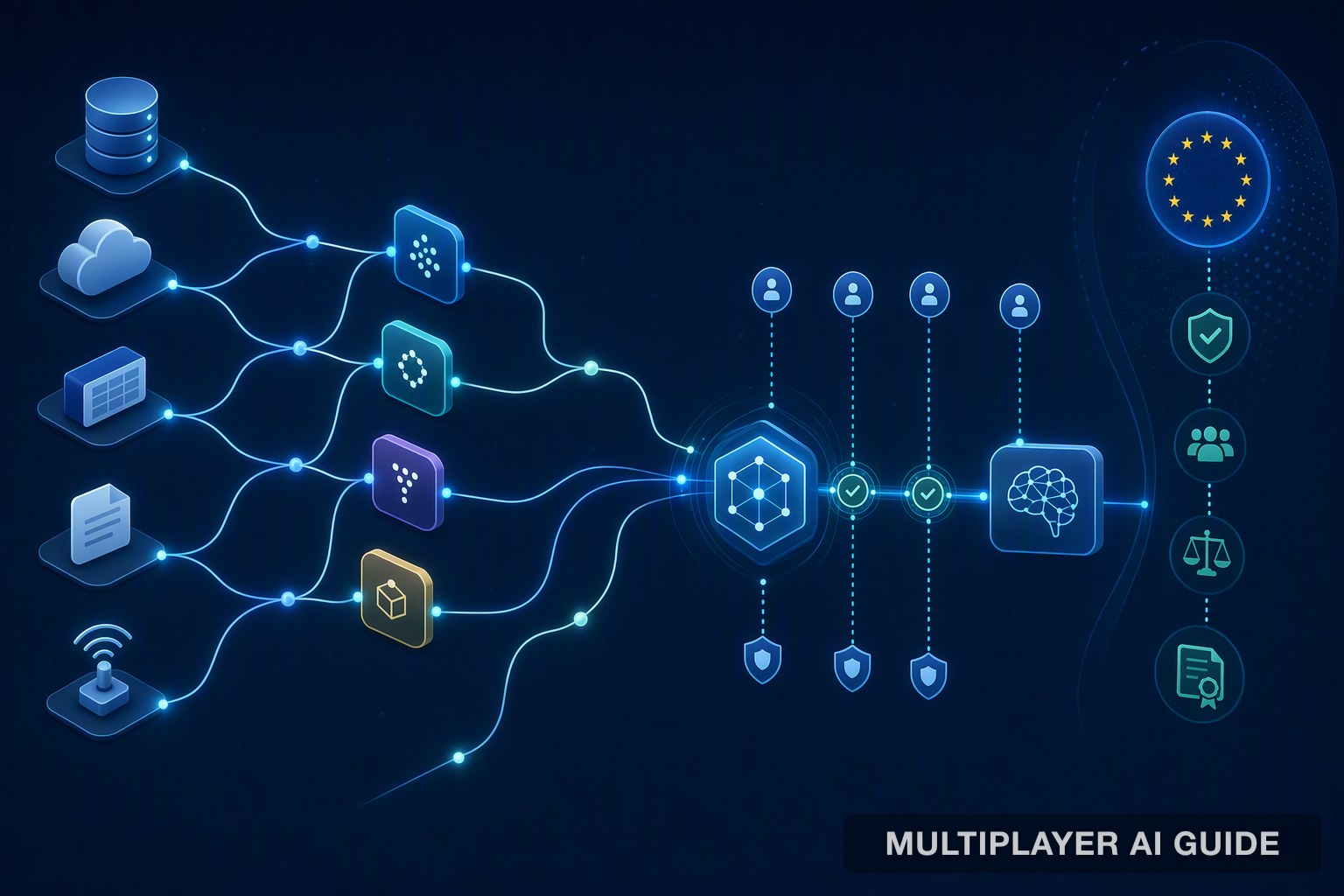
8 Best AI Tools for Data Provenance and Lineage Tracking in 2026
We compared the top AI tools for data provenance and lineage tracking, covering deterministic agent execution, automated column-level mapping, and enterprise governance platforms.
We compared the top AI tools for data provenance and lineage tracking, covering deterministic agent execution, automated column-level mapping, and enterprise governance platforms.
The moment your procurement team asks whether a new open-source model was fine-tuned on a distillate of a restricted-weight model from a sanctioned market, your governance framework has a problem. Data provenance and lineage tracking is what answers that kind of question: the practice of surfacing a verifiable derivation history for both your data and your models, where something originated, what it passed through, and what produced the final output. The stakes are real. The EU AI Act can levy fines of up to €35 million or 7% of worldwide annual turnover, whichever is higher, and until recently most teams lacked the forensic tools to answer a base-ancestry question reliably.
With 61% of organizations rethinking their data operating model because of AI, the tools below aren't nice-to-have metadata layers. They span deterministic AI agent execution, automated column-level mapping, weight-agnostic ancestry detection, behavioral fingerprinting, and enterprise governance platforms. Most teams end up combining more than one: a data-lineage platform for pipeline visibility, and an AI agent layer like PromptQL whose own outputs carry an audit trail, the same way teams pair a database-connected AI agent with a governance layer rather than expecting one tool to do both jobs.
Key Takeaways
Provenance is no longer a publisher trust exercise, it is an empirical capability. Here is what the 2026 landscape demands:
- Deterministic execution creates a free audit trail: When a plan-based architecture pre-declares its steps, it produces a referenceable provenance graph automatically, no separate documentation needed.
- Ancestry hides in behavior, not just weights: Cisco MPK and VAIL show that post-training behavioral signatures survive distillation and fine-tuning. For Nemotron models with documented Qwen base-weight ancestry, the observed neighbor share reaches 28.1% against a 14.9% catalog base rate, a 1.89x enrichment, meaning procurement teams now need to verify lineage forensically rather than relying on release notes alone.
- Automation is non-negotiable: Manual data lineage documentation breaks the moment a pipeline changes. Cloud-native platforms like Snowflake and Databricks capture column-level lineage as a byproduct of query execution.
- Open-source and proprietary tools coexist: Apache Atlas provides a vendor-neutral governance baseline, while Collibra and Alation wrap that foundation in regulatory policy and persona-driven adoption layers.
- Regulatory exposure is here: The EU AI Act penalty structure makes provenance a board-level risk. The stack now needs to produce evidence, not assertions.
Best AI Tools for Data Provenance and Lineage Tracking
| Tool | Best For | Provenance Type | Deployment |
|---|---|---|---|
| PromptQL | AI agents needing auditable answers | Query and output-level audit trail | Dedicated VPC, BYOC, or on-prem |
| Cisco Model Provenance Kit | Vetting third-party model ancestry | Weight-derived artifact similarity | Self-hosted, open-source |
| VAIL | Behavioral model fingerprinting | Inference-level behavioral similarity | API-based |
| Snowflake | Cloud data warehouse teams | Automated column-level lineage | Cloud-native |
| Databricks Unity Catalog | Lakehouse ML and Gen AI workloads | Unified table-to-model lineage | Cloud-native |
| Apache Atlas | Vendor-neutral governance baseline | Technical and operational lineage | Self-hosted, open-source |
| Collibra | Regulated enterprises | Policy-linked technical lineage | Cloud or hybrid |
| Alation | Adoption-focused governance teams | Persona-driven active lineage | Cloud or hybrid |
1. PromptQL
Most agent architectures leave an audit trail that resembles a black-box hallucination trail. PromptQL takes a fundamentally different architectural bet: it generates a plan first, then executes it deterministically against structured data sources.
Key features:
- Pre-declared lineage: Execution steps are declared before a single data point is accessed, creating a referenceable provenance graph up front instead of requiring auditors to reverse-engineer a sequence of LLM tool invocations after the fact.
- Cell-level audit granularity: Each output ties to the specific data artifact and transformation step that produced it, rather than leaving tool-selection logic and intermediate reasoning opaque to governance review.
- Zero generative variance on computation: The plan is fixed and executed, which removes the compounding error risk that comes from a probabilistic, generated plan.
- Regulatory-ready output: Produces a static execution log that maps directly to compliance attestation frameworks, instead of requiring post-hoc sampling to reconstruct what happened.
- Isolated deployment: According to the company, PromptQL deploys inside a single-tenant VPC, BYOC, or on-prem, which matters because provenance signals are themselves sensitive: they reveal system topology, access patterns, and model lineage that can cross geopolitical boundaries.
Trade-off: Plan-based execution works best against structured, connected data sources. Teams whose provenance needs center on unstructured document sprawl may still want a wiki or knowledge base layer alongside it.
Best for: Teams that need every AI-generated number or answer to trace back to a specific data artifact and transformation step, without retrofitting documentation after the fact.
Plan-based execution is arguably the most direct answer available to the regulatory question of "show me how you got there." Every transformation can be traced, role-based permissions apply down to the row and column level, and a tamper-evident computation log is generated without extra work. The governance artifact is the system architecture itself, not a retrofit bolted on afterward. That's a different foundation than tools built around a static memory store, where a saved fact can't be traced back to the live source that produced it.
2. Snowflake
Snowflake treats lineage as a byproduct of system telemetry. The platform ingests metadata automatically, capturing column-level dependencies as queries, views, and pipelines execute. In a cloud estate where thousands of AI models might read from the same customer data mart, waiting for a data steward to draw a lineage diagram by hand is not a realistic option.
Key features:
- Self-updating dependency map: Tracks how data moves from raw ingestion tables into feature engineering views, into model training sets, and then into the inference outputs hitting an application, all timestamped and versioned.
- Automatic capture at query time: Lineage updates as queries, views, and pipelines run, with no manual diagramming required.
- Compliance-ready record: Points auditors at an always-current record of data movement instead of producing a lineage report weeks after it's requested.
Trade-off: Native Snowflake lineage is strongest inside the Snowflake ecosystem itself; teams with heavily fragmented, multi-warehouse estates may still need a cross-platform catalog layered on top.
Best for: Teams already standardized on Snowflake who want lineage to appear automatically rather than being documented separately.
Manual lineage documentation breaks the moment a pipeline changes at pace, and 29% of organizations plan to revamp how they manage data assets over the next 12 to 18 months for exactly this reason. Under a regulatory regime where fines reach 7% of worldwide turnover, the gap between an always-current record and a four-week-old report is not a convenience difference, it is an economic one.
3. Cisco Model Provenance Kit (MPK)
The Cisco Model Provenance Kit redefines what a sourcing team can verify before a model ever touches internal data. Published in August 2026 by Amy Chang and colleagues, the research demonstrates that MPK identifies model neighborhood relationships without access to original training weights. It surfaces hidden dependencies, like Qwen ancestry inside NVIDIA's Nemotron family, that publisher labels alone do not disclose.
Key features:
- Artifact-level analysis: Compares architecture metadata, tokenizer structure, and weight-derived signals rather than relying on self-reported documentation.
- Documented enrichment: In Cisco's 184-model catalog, Qwen models account for 20.9% of the neighborhoods of the 22 Nemotron references with documented Qwen base-weight ancestry, against a 12.0% catalog base rate, a 1.74x enrichment. Across all 37 Nemotron references, the enrichment is 1.27x, with a 95% confidence interval of 0.99x to 1.56x.
- Catalog-scale screening: Applies statistical enrichment detection across a catalog of 184 models, so a CISO can screen a fine-tuned release from Hugging Face before it enters production.
Trade-off: MPK's findings are evidentiary, not conclusive. Cisco itself frames similarity as detection evidence that can motivate further inquiry, not proof of a specific derivation chain.
Best for: Security and procurement teams vetting third-party or open-weight models before deployment, particularly where publisher labels alone aren't sufficient for a compliance review.
For supply chain security, this capability changes the threat model. Statistical enrichment detection can now run across a full model catalog before anyone has to debate the provenance of a fine-tuned release informally. That shifts model procurement from a trust-based exercise toward an evidence-based one.
4. VAIL
VAIL works orthogonally to MPK. Instead of analyzing static weight relationships, it fingerprints models by observing their interactive behavioral patterns across a catalog of 1,159 models. The technique is weight-agnostic, so it works even in settings with zero access to the underlying model files, only an API or chat endpoint.
Key features:
- Weight-agnostic detection: Operates purely on inference behavior, so it can fingerprint models where the weights themselves are inaccessible.
- Documented enrichment: Qwen models constitute 28.1% of the neighborhoods for the 27 Nemotron models with documented Qwen ancestry, versus a 14.9% catalog base rate, a 1.89x enrichment.
- Survives repackaging: The signal holds up through fine-tuning, distillation, and release under a different publisher name, confirming the fingerprint isn't erased by post-training alone.
Trade-off: Behavioral similarity is a detection signal, not causal proof. Cisco and VAIL's own research notes it can also arise from shared architectures, tokenizers, or training objectives rather than direct lineage.
Best for: Teams needing a second, independent signal alongside MPK, or teams that only have API access to a model and no weight files to inspect.
Even when a model card omits ancestry information entirely, the fingerprint can still be detected through agent interaction alone, cutting through what a publisher chooses to disclose on paper.
5. Databricks Unity Catalog
Unity Catalog makes provenance visible across the Databricks Lakehouse platform: SQL analytics, notebook-driven ML training, and generative AI feature pipelines all contribute to the same lineage graph. That is what a single pane of glass delivers when analysts use Python, data scientists call MLflow tracking endpoints, and the governance team audits lineage from a central interface.
Key features:
- Table-to-column depth: Lineage starts at table dependencies and drills into column transformations, recording which columns fed a model and which downstream columns consumed its output.
- Unified metadata store: Notebooks, jobs, ML models, and Gen AI features share one catalog, avoiding a fragmented audit where SQL lineage lives in one tool, ML lineage in a separate experiment tracker, and Gen AI data movement in a third silo.
- Consistent access governance: The same permissions model applies whether a data engineer is querying feature store columns or a compliance officer is reviewing model provenance.
Trade-off: The unified view is strongest for teams fully inside the Databricks Lakehouse; workloads split across multiple platforms will see partial lineage graphs.
Best for: Teams running SQL, ML training, and Gen AI feature pipelines on the same lakehouse who want one lineage graph instead of three disconnected ones.
Because Unity Catalog sees everything from ETL ingestion to model serving, it's possible to trace how a specific raw dataset moves through feature engineering, trains a production model, and drives a prediction that reaches a customer.
6. Apache Atlas
Apache Atlas is the open-source reference implementation for metadata governance, and it remains relevant in 2026 for organizations that need lineage without a commercial contract. It captures technical, operational, and business lineage within the Hadoop ecosystem and integrates outward through REST APIs and Kafka hooks.
Key features:
- Auditable entity graph: Captures dependency chains from raw HDFS datasets through Spark and Hive transformations into BI tables, surfaced as a queryable entity graph. Teams building similar dependency graphs for AI-readable knowledge structures will recognize the same underlying problem tackled by dedicated knowledge graph tools.
- Broad integration surface: Atlas connectors and the Kafka hook extend ingestion into cloud-native stores, S3-backed data lakes, Snowflake pipelines, and Databricks workloads.
- Vendor-neutral governance: Apache-governed, with no single commercial vendor controlling the roadmap.
Trade-off: Maintenance overhead is real. Running an Atlas server, managing the Kafka sync, applying patch releases, and monitoring integration health all fall on the team, not a vendor.
Best for: Organizations where a vendor-neutral, Apache-governed lineage infrastructure is itself a compliance requirement.
For some regulated shops, that open governance model isn't a nice-to-have, it's non-negotiable.
7. Collibra
Collibra operates at the intersection of regulatory policy and technical asset lineage. It layers AI governance capabilities onto a mature data catalog foundation, bridging what a CDO needs to attest in an EU AI Act filing and the column-level lineage a data engineer traces through a pipeline.
Key features:
- Glossary-to-lineage mapping: The business glossary ties directly to technical lineage graphs. Defining a regulatory obligation for a business concept, such as a personally identifiable financial performance indicator, maps that concept to every physical column, model training batch, and dashboard tile where it surfaces.
- Governance posture that updates: If the lineage path shifts, the governance posture updates alongside it, rather than requiring a manual re-attestation.
- Historical lineage snapshots: Captures not just current lineage but historical lineage states, so a compliance officer can ask what the lineage topology looked like at a specific point in the past and get a point-in-time answer.
Trade-off: Collibra's strength is regulatory and policy alignment; teams whose primary need is raw technical lineage speed may find lighter-weight tools faster to deploy.
Best for: Regulated enterprises that need lineage tied directly to a business glossary and a defensible compliance history, similar to how teams evaluate enterprise data intelligence platforms for governed search and discovery.
Preserving past lineage state is increasingly non-negotiable under the €35 million penalty regime, where proving past compliance depends on being able to reconstruct what was true at the time.
8. Alation
Alation solves a different problem with lineage: adoption. A technically perfect lineage graph that data analysts cannot navigate, query, or trust is governance theater. Alation builds persona-driven lineage, surfacing the depth and detail appropriate to a data engineer versus a compliance officer versus a business analyst.
Key features:
- Active cataloging: Continuously crawls metadata, query logs, and usage patterns to keep lineage current without manual upkeep.
- Collaborative context layer: Adds stewardship annotations, trust flags, and analyst commentary on top of raw technical lineage, turning it into a decision-making fabric rather than a static asset register.
- Persona-driven surfacing: Tailors what's shown to who's asking, closing the gap between a perfectly governed system and a team that actually consults lineage before making a call.
Trade-off: The adoption-first design trades some of the deep technical granularity that engineering-heavy teams might want from a tool like Apache Atlas.
Best for: Organizations where lineage exists on paper but isn't actually consulted day to day, and low weekly active usage is itself the governance gap to close.
How to Choose the Right Tool for Yourself
The right tool depends on which provenance question actually needs answering:
- Vetting a third-party or open-weight model before deployment: Cisco MPK or VAIL, used together where possible since they observe different surfaces of the same model.
- Tracing how your own pipeline's data moves and transforms: Snowflake or Databricks Unity Catalog if already standardized on one of those platforms, Apache Atlas for a vendor-neutral open-source baseline.
- Meeting a formal governance or regulatory mandate: Collibra for policy-linked lineage tied to a business glossary, Alation where the real gap is getting teams to actually use the lineage that already exists.
- Needing an AI agent whose own answers carry an audit trail: PromptQL, where the provenance graph is generated as a byproduct of how the agent executes rather than documented separately, and where the audit trail stays intact even as the same shared workspace is used by an entire team rather than one person.
Most teams end up combining two or three of these rather than picking one tool for every job. A data-lineage platform answers where a number came from; an AI agent layer like PromptQL answers what the AI did with it, and why it's traceable back to that number in the first place.
Conclusion
The 2026 provenance stack makes one thing clear: the best tools treat lineage as an automatic architectural byproduct, not a separate governance burden. PromptQL does it through deterministic plan-based execution. Snowflake and Databricks capture it as a side effect of query telemetry. Cisco MPK and VAIL dig ancestry out of model fingerprints post-training.
The €35 million or 7% of worldwide annual turnover penalty threat is not theoretical. It changes the sourcing calculus. If you cannot produce a defensible provenance record for every model in production within a reasonable audit window, you are carrying a regulatory exposure that your board probably has not priced. The tools above make that record cheap enough to be non-optional.
Frequently Asked Questions
What is data provenance and lineage tracking in AI tools, and why does it matter for enterprise AI?
It captures a verifiable derivation history of model weights and training data, which base models, datasets, or signals contributed to a final artifact. It matters because models inherit components across borders, and regulators can fine up to 7% of global turnover under the EU AI Act.
How do AI tools with data provenance enforce security and compliance at the data layer?
They capture column-level metadata, dependency maps, and access patterns during query execution. This creates an automatic, tamper-evident record of how data moved through the system, supporting HIPAA and CCPA attestations without requiring manual documentation that breaks under pipeline velocity.
What is the difference between a plan-based execution model and a tool-calling or RAG-based system?
Plan-based execution pre-declares every transformation step before accessing data, producing a deterministic provenance graph. Tool-calling and RAG agents generate reasoning chains probabilistically. The former produces a static audit artifact; the latter requires post-hoc reconstruction of what the LLM decided to do and why.
Which AI tools offer built-in data provenance and lineage tracing as of 2026?
PromptQL uses plan-based deterministic lineage. Snowflake captures automated column-level lineage. Databricks Unity Catalog unifies lineage across lakehouse workloads. Cisco MPK detects weight-agnostic model ancestry. VAIL fingerprints post-training behavioral signatures. Apache Atlas provides open-source metadata governance.
Sources
Last verified: 2026-09-08