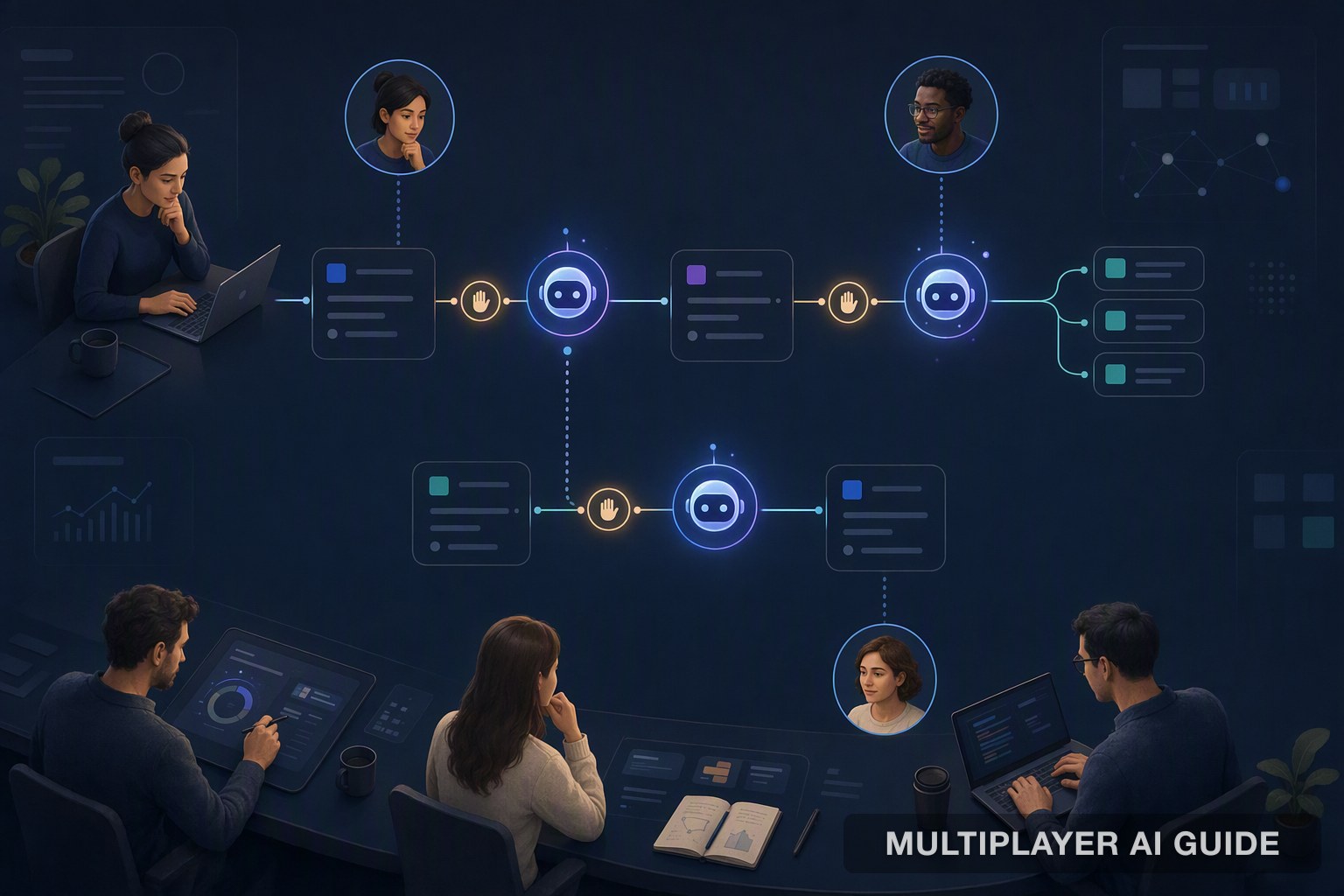
7 Best Platforms for Human and AI Agent Collaboration
We compared the top platforms for human-AI agent collaboration, covering how each handles handoffs, oversight, and team workflows where people and agents work side by side.
We compared the top platforms for human-AI agent collaboration, covering how each handles handoffs, oversight, and team workflows where people and agents work side by side.
A team can burn multiple sprints wiring up a single internal analytics agent, with the model solid and the deployment straightforward, and still watch the coordination between humans and the agent collapse immediately. Who owns the thread state? What happens when someone corrects the agent's output in Slack but the data warehouse still shows the old numbers?
These are not model problems. They are platform problems.
In 2026, a human-AI collaboration platform is software that combines team communication, knowledge management, and workflow automation into a shared space where people and agents operate side by side. The market has split into three clear lanes: developer frameworks that give maximum control, opinionated enterprise platforms that trade flexibility for turnkey governance, and no-code authoring surfaces embedded inside existing productivity stacks.
The tension shaping every deployment decision is security versus capability. An agent that can query every database and post to every channel is also an agent that can leak every database and confuse every channel. The platforms below are the ones solving that tension with architectural choices rather than policy band-aids.
Key Takeaways
The platforms worth attention in 2026 share one property: they force a decision upfront about how humans and agents share authority. That governance choice, more than any feature comparison, predicts whether a deployment sticks or stalls.
- The HIL vs. AI²L distinction is the first question: In human-in-the-loop systems, AI drives and humans correct; in AI-in-the-loop systems, the human is in control while AI assists with perception, inference, and action. Most enterprise tools claiming HIL are actually running AI²L. Knowing which one is needed matters before evaluating any platform.
- PromptQL uses plan-based execution and deterministic audit, appealing to governed enterprise environments that need referenceable outputs across reasoning steps.
- OpenAgents is the shared-thread collaboration OS where humans and agents interact via @mentions, with local code execution solving the credential problem.
- Coworker AI offers an opinionated enterprise builder with SOC 2 Type 2 compliance built in, aimed at teams that want to skip the build-versus-buy decision.
- Microsoft Copilot Studio embeds no-code agent authoring inside the Microsoft Graph, making it the default choice for organizations already living in Teams and Outlook.
- CrewAI gives developers role-based multi-agent orchestration, moving beyond single-agent patterns to defined team structures with assigned jobs.
- LangChain remains the foundational composable framework for custom agentic workflows, offering maximum flexibility at the cost of maximum engineering demand.
- Oracle Fusion Cloud AI Agents ships the Agent2Agent protocol for cross-platform interoperability, making it a bellwether for how multi-agent ecosystems will connect.
What to Look for in a Human and AI Agent Collaboration Platform
Before comparing specific platforms, it helps to know which architectural choices actually determine whether a deployment works:
- Authority model: Does the platform make it clear whether the AI drives and the human corrects, or the human drives and the AI assists? Vague authority splits are where deployments stall.
- Credential handling: Does the agent act with broad platform-level credentials, or with each user's individual permissions? The former is a bigger blast radius if something goes wrong.
- Where code executes: Local, on the user's own machine or cloud, versus hosted on the vendor's infrastructure. This determines what data and credentials ever leave the organization's environment.
- Auditability: Can an output be traced back through the specific reasoning steps and tool calls that produced it, or does the platform hand over a result with no inspectable trail?
- Shared knowledge persistence: Does a correction or a piece of context stick for the whole team going forward, closer to how a dedicated AI wiki accumulates knowledge, or does it live only inside one person's session?
- Deployment surface: No-code authoring for business teams, a developer framework for full control, or a turnkey enterprise product, matched to the team's actual engineering capacity.
- Interoperability: Does the platform lock agents into one ecosystem, or can agents discover and call each other across platforms and vendors?
- Governance rigidity versus flexibility: More opinionated platforms move faster to deploy but decide more architectural questions in advance. More open frameworks give full control at the cost of owning the operational burden.
Best Platforms for Human and AI Agent Collaboration
The platforms below are compared on the choices that matter most: who holds decision authority, where code runs, and how much engineering investment each one demands.
| Platform | Best For | Authority Model | Deployment Surface |
|---|---|---|---|
| PromptQL | Governed enterprise environments needing referenceable audit trails | Plan-based, deterministic execution | User-owned sandbox, VPC/BYOC |
| OpenAgents | Teams that want a shared workspace where humans and agents co-exist | Shared threads, @mention delegation | Local execution via Launcher, open source |
| Coworker AI | Teams that want a finished product without a build-versus-buy decision | Opinionated enterprise builder | Hosted, native connectors |
| Microsoft Copilot Studio | Organizations already living in Teams and Outlook | No-code authoring inside the Microsoft Graph | Hosted, Microsoft ecosystem |
| CrewAI | Developers building multi-agent workflows with defined roles | Role-based agent orchestration | Self-hosted Python framework |
| LangChain | Teams that need full control over custom agentic workflows | Composable, developer-defined | Self-hosted, build-your-own |
| Oracle Fusion Cloud AI Agents | Enterprises running heterogeneous, cross-platform agent stacks | Agent2Agent protocol, cross-platform discovery | Hosted, protocol-level interoperability |
With the landscape mapped out, here is how each platform works in practice.
1. PromptQL
PromptQL approaches the enterprise AI collaboration problem with a fundamentally different execution model: plans before actions, audit after every step, and computation happening in a sandbox the customer controls.
Key features:
- Deterministic execution: Instead of launching a probabilistic agent that reasons as it goes, PromptQL generates an explicit plan first, then executes it. Every output traces back through the reasoning steps and tool calls that produced it, which matters in regulated industries that need to show why an agent returned a particular conclusion.
- User-owned sandbox: PromptQL runs code in the user's own cloud or on-prem, including single-tenant VPC and BYOC deployments. Data stays in the organization's environment, and the AI acts with each user's permissions rather than wielding broad agent-level credentials.
- Data-layer permissions: Role-based access controls enforce deterministically down to row and column level.
- Multiplayer with shared context: The platform functions as a multiplayer AI agent with shared threads and a shared brain, where a team corrects the model once and the fix sticks for everyone. Every interaction happens inside a thread, and public thread sharing lets specific conversations surface without exposing internal project data.
Trade-off: The plan-based approach is strongest against structured, connected data sources. Teams whose workflows lean heavily on unstructured, exploratory reasoning may find the upfront planning step adds friction rather than removing it.
Best for: Governed enterprise environments that need every agent output traceable back through a deterministic, auditable chain.
2. OpenAgents
Imagine a Slack workspace where half the participants are AI agents, not bots firing off canned responses, but reasoning agents that receive @mentions, attach files, complete tasks, and show their work in a shared thread. That is the OpenAgents proposition, and it is one of the more coherent workspace metaphors in the collaboration space.
Key features:
- Split architecture: The Workspace runs in the browser and coordinates threaded conversations, shared files, a knowledge base, task tracking, and routines. It relays messages and shares context but never executes code itself.
- Local execution via the Launcher: A desktop app installs and runs agents on the user's own machine. Claude Code, Codex, Aider, and more connect through it, and their computation stays local, so no raw credentials ever sit on the platform side.
- Open protocols throughout: The stack runs over open protocols including MCP, and the entire platform is open source, with self-hosting available for enterprise teams that need full control.
- Fast onboarding: A new user can sign in, connect an agent via a cloud API key or pairing code, and delegate a task by @mentioning an agent in a thread in about 60 seconds.
Trade-off: That onboarding speed does not automatically come with enterprise governance built in; teams with strict compliance requirements will want to evaluate the self-hosted deployment path rather than the fastest path to a working demo.
Best for: Teams that want a shared workspace metaphor, humans and agents in the same threads, files, and tasks, without being locked into one agent vendor.
3. Coworker AI
Coworker AI takes the opposite approach from OpenAgents. Where OpenAgents provides an open-source platform and lets a team wire up any agent it wants, Coworker AI ships a finished enterprise product that decides many architectural questions in advance. For organizations that want to skip the build-versus-buy debate, this is the turnkey answer.
Key features:
- Native connectors: The platform connects to a range of common enterprise tools including Slack, Salesforce, Jira, Google Workspace, and GitHub.
- Organizational memory layer: Its OM1 architecture pulls context from a company's interaction history across those systems so agents arrive with institutional knowledge instead of starting cold with every prompt, a different approach to persistent context than the memory architectures built into general-purpose assistants.
- No-code agent builder: The built-in agent builder lets non-engineering teams create and deploy agents without a developer translating between business logic and API calls.
- Compliance built in: SOC 2 Type 2 compliance comes with the platform rather than being bolted on separately.
Trade-off: The opinionated, finished-product design trades away the granular control a developer framework offers; teams with unusual architectural requirements may find themselves working around the platform's defaults rather than with them.
Best for: Organizations that want a turnkey enterprise platform and are willing to accept its architectural decisions in exchange for a faster path to deployment.
4. Microsoft Copilot Studio
Microsoft Copilot Studio wins on one dimension none of the other platforms on this list can touch: it already knows an organization's org chart. The Microsoft Graph provides a pre-built map of identities, groups, meetings, documents, and data relationships. An agent authored inside Copilot Studio can access all of it on day one without any integration work.
Key features:
- No-code authoring: The authoring surface is designed for business teams rather than developers, with agents deploying directly into Teams, Outlook, and the Power Platform.
- Native Microsoft Graph access: Identity, groups, meetings, documents, and data relationships are available to an agent immediately, with no separate integration step.
- Ecosystem-native governance: The governance model follows whatever the Microsoft Graph and tenant policies already dictate, rather than requiring a separate governance layer to be built.
Trade-off: Agents are built the Microsoft way, inside the Microsoft ecosystem, and the governance model that comes with it. For teams whose collaboration workflows already live there, that constraint feels more like a feature than a limitation, but it is a real constraint for anyone stepping outside that ecosystem.
Best for: Organizations already standardized on Microsoft 365 that want no-code agent deployment without a separate integration project.
5. CrewAI
CrewAI solves a problem that surfaces the moment a team moves past single-agent experiments. One agent, one prompt, one set of tools works fine for simple questions. But as soon as one agent needs to research, another needs to draft, and a third needs to critique, the workflow needs distinct roles, responsibilities, and communication patterns, the same multi-agent coordination problem that shows up when comparing AI agents built for Slack. The agents need to behave like a team.
Key features:
- Role-based agent structure: Agents are defined with roles, goals, backstories, and tools, rather than one agent trying to hold every instruction in a single prompt.
- Sequential and hierarchical delegation: Tasks distribute across agents according to defined structure, rather than branching only inside one agent's context.
- Declarative developer experience: Agents and tasks are defined declaratively in Python, and the framework handles delegation and sequencing rather than requiring hand-built orchestration logic.
- Bounded context per agent: Each agent's context stays scoped to its role, which shrinks the hallucination surface that plagues monolithic agents trying to hold too many instructions at once.
Trade-off: Role-based orchestration adds a layer of design work up front, defining roles, goals, and delegation patterns, that a single-agent setup does not require.
Best for: Development teams building workflows that need specialized agents coordinating on a shared objective rather than one agent handling everything.
6. LangChain
LangChain is the framework underneath most custom enterprise agent deployments in 2026. It is not a platform to buy, it is a framework to build on, composed of chains, tools, memory modules, and an ecosystem of integrations connecting to most LLM providers, vector stores, and data sources in production.
Key features:
- Composable pipeline design: A retrieval step, a reasoning step, a tool-calling step, and a human-review step can be chained together without hand-writing orchestration glue, since the framework handles context-passing between stages.
- Broad integration ecosystem: Connectors span most major LLM providers, vector stores, and data sources already common in production stacks, including the database-connected agent patterns that show up across LangChain SQL Agent deployments specifically.
- Pairing with governed data access: Databricks Unity Catalog provides one governed source of data access with row and column level controls, automatic lineage, and audit logs covering every table, model, and tool an agent touches, filling part of the governance gap LangChain leaves open by default. MLflow traces agent decisions back to inputs and tool calls, which matters in regulated industries.
Trade-off: The composability is the advantage and the cost. A team is responsible for the deployment environment, the permission model, the audit trail, the error handling, and the monitoring, full control paired with full operational ownership.
Best for: Teams with the engineering capacity to own custom agent logic end to end and the need for flexibility a pre-built platform cannot offer.
7. Oracle Fusion Cloud AI Agents
Oracle's contribution to the human-AI collaboration space in 2026 is not a new platform, it is a protocol. Oracle Fusion Cloud Applications supports the Agent2Agent (A2A) protocol for cross-platform AI agent collaboration, meaning published AI agents in Oracle can talk to agents running on other platforms using a standard discovery and invocation model.
Key features:
- Agent Cards for discovery: Agents publish a card describing their capabilities, authentication requirements, and invocation endpoints, so other agents can discover and call them through a registry.
- Standard invocation model: Other agents authenticate and call a published agent via a standard request-and-response API, rather than requiring custom integration work per pair of agents.
- Shared lifecycle for long-running tasks: For asynchronous or long-running work, the protocol includes a shared lifecycle so agents can coordinate across execution boundaries without polling endlessly or losing state.
Trade-off: This is infrastructure-level plumbing, not a user-facing product. Its value depends heavily on how much of an organization's agent stack runs across multiple platforms and vendors in the first place.
Best for: Enterprises running heterogeneous AI stacks across different cloud providers and business units that need agents on different platforms to discover and call each other.
How to Choose the Right Tool for Yourself
The right fit depends on which side of the security-versus-capability tension matters most, and how much engineering capacity is available to manage it:
- Need every output traceable through a deterministic, auditable chain: PromptQL, for regulated environments where showing the reasoning behind a conclusion is not optional.
- Want a shared workspace where humans and agents work in the same threads without vendor lock-in: OpenAgents, especially where local code execution and open protocols matter.
- Want a finished enterprise product without a build-versus-buy decision: Coworker AI, for teams that would rather accept a platform's defaults than build their own.
- Already standardized on Microsoft 365: Copilot Studio, for no-code agent deployment with native access to existing identity and data.
- Building multi-agent workflows with developer resources: CrewAI for role-based orchestration, LangChain when the workflow needs more custom control than a pre-built framework offers.
- Running agents across multiple platforms and vendors: Oracle's A2A protocol implementation, or any platform that supports the same interoperability standard.
Most organizations will not settle on one platform for every use case. A common pattern is a developer framework for custom, high-stakes workflows and a turnkey platform for everything else, connected by whatever interoperability standard becomes common ground between them.
Conclusion
Three variables drive the platform choice: engineering capacity, governance rigidity, and whether agents operate in one ecosystem or span several.
Teams with developer bandwidth and a need for flexibility tend to start with a composable framework and add role-based orchestration once workflows grow past single-agent patterns. Teams already living inside one ecosystem gain the most from a no-code authoring surface embedded there. Teams that want a turnkey enterprise setup are choosing between architectures, not just vendors, and the protocol layer connecting agents across platforms is where cross-platform work is heading next.
The wrong move is not the platform choice. It is deploying agents before answering the governance questions those agents will force the moment they touch real data and real decisions.
Frequently Asked Questions
What are the best platforms for human and AI agent collaboration in 2026?
The top platforms span three categories: - Developer frameworks: like LangChain and CrewAI for custom builds - Opinionated enterprise platforms: like Coworker AI and PromptQL for turnkey deployments - No-code authoring surfaces: like Microsoft Copilot Studio embedded inside existing productivity stacks
How do platforms differ in features for human-AI agent collaboration?
The core differentiators are execution model, governance architecture, and deployment surface: - PromptQL: uses plan-based deterministic execution - OpenAgents: provides a shared workspace with @mentions and local agent execution - Coworker AI: ships a built-in agent builder - CrewAI: structures multi-agent teams with roles - LangChain: offers composable chains and tools for custom workflows
What security and governance considerations exist when choosing a human-AI collaboration platform?
The central security decision is whether the AI agent acts with broad platform-level credentials or with each user's individual permissions. Platforms like OpenAgents keep code execution local so credentials never leave the user's machine. PromptQL enforces role-based permissions deterministically at the data layer. Audit trails and compliance certifications like SOC 2 Type 2 vary by vendor.
How do platforms like PromptQL enforce permissions and data governance during AI collaboration?
PromptQL enforces role-based permissions down to the row and column level, with the AI acting under each user's authorization rather than wielding its own credentials. Execution happens in a user-owned sandbox, including single-tenant VPC and BYOC deployments, so data stays in the customer's environment.
How do human-AI collaboration platforms handle integration with existing enterprise data systems?
Integration depth depends on the platform category: - Coworker AI: ships native connections to over 40 tools including Slack, Salesforce, Jira, and GitHub - Microsoft Copilot Studio: draws identity and data context from the Microsoft Graph automatically - LangChain: provides composable connectors to virtually every vector store, database, and SaaS source, but requires engineering investment to wire them up securely
Sources
- Overview | Docs | PromptQL - promptql.io
- Human-in-the-loop or AI-in-the-loop? Automate or Collaborate? - arXiv - arxiv.org
- 8 Best AI Agent Builders for Enterprise Teams (2026) | Coworker AI - coworker.ai
- 7 Best AI Collaboration Tools and Platforms for Enterprise Teams in 2026 - www.gosearch.ai
- OpenAgents Overview: The Collaboration OS for AI Agents - openagents.org
- What software provides enterprise-grade data governance for custom AI agents? | Databricks Developer - developers.databricks.com
- Collaborate with AI Agents in other platforms using the Agent2Agent (A2A) Protocol - docs.oracle.com
Last verified: 2026-09-08