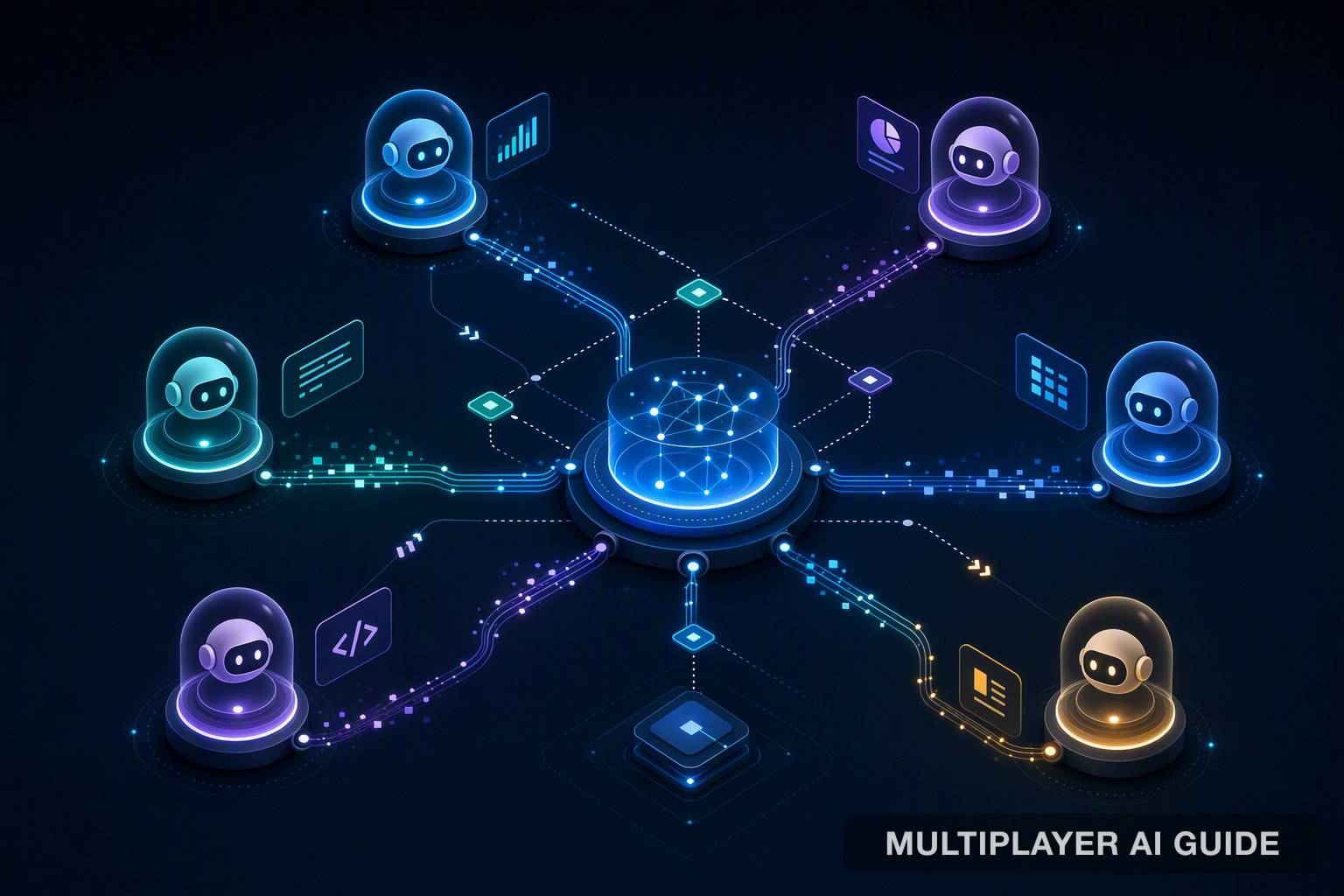
7 Best Multi-Agent Collaboration Platforms in 2026
We compared the top multi-agent collaboration platforms, covering how each handles agent-to-agent communication, orchestration, and team-scale deployment.
We compared the top multi-agent collaboration platforms, covering how each handles agent-to-agent communication, orchestration, and team-scale deployment.
A lot of engineering teams are standing at the same cliff right now. A dozen AI agents ship into production, and then the security audit comes back. A governance-centric approach documented in a recent SecureGov-Agent study cut attack success rates by 73.2% and privacy leakage rates by 81.4% compared to running those same multi-agent systems unprotected, a gap that shows just how exposed an unprotected system is by comparison. The playbook that worked for single-prompt LLMs does not hold once agents start talking to each other.
This is a production concern, not a theoretical one. The core shift in 2026 is building agents that do not leak PII or execute poisoned tool calls from a neighboring agent. Evaluating a platform now means prioritizing governance architecture first, a different lens than evaluating a platform built for human oversight of a single agent, where the question is who holds decision authority rather than how agents behave toward each other. The conversation has moved from "can the agent do the task" to "can the system prove the agent did not compromise the firm."
In this article, we compare 7 platforms for multi-agent collaboration, from plan-based execution and centralized governance agents to infrastructure-level containment, and break down what to look for before trusting any of them with agents that talk to each other.
Key Takeaways
The governance model is the platform. Here are the dimensions that matter most when comparing options:
- Security architecture: Dedicated governance agents that perform multi-perspective risk scoring are becoming the baseline. The SecureGov-Agent framework demonstrates what a governance-centric approach can achieve: a 73.2% cut in attack success rate compared to an unprotected system.
- Privacy protection: The same framework cut privacy leakage rates by 81.4% compared to unprotected systems, evidence that a dedicated governance layer measurably changes exposure, not just theoretically reduces it.
- Performance trade-off: Security has a cost, but it does not have to break an SLA. SecureGov-Agent maintained an 89.7% task completion rate while adding only about 15.3% latency overhead from the security layer, a useful reference point for what "acceptable overhead" looks like.
- Centralized vs. decentralized governance: Some platforms route every inter-agent message through one policy checkpoint; others distribute governance as modular, developer-defined controls. Neither is universally better, the right choice depends on engineering capacity and regulatory requirements.
What to Look for in a Multi-Agent Collaboration Platform
Before comparing specific platforms, these are the architectural choices that actually determine how exposed a multi-agent deployment is:
- Governance centralization: Does every inter-agent message and tool call route through a single policy checkpoint, or is governance distributed as separate, developer-defined controls across the system?
- Pre-execution vs. reactive enforcement: Does the platform block a risky action before it happens, or does it catch policy violations after the fact through a guardrail layer bolted on afterward?
- Determinism and auditability: Can a specific decision be traced back through an inspectable, step-by-step plan, or does the system only reveal input-output pairs with no visibility into the reasoning between them?
- Collusion resistance: Can two agents that share a memory bus or communication channel coordinate to bypass a rule that either one alone would be blocked from breaking?
- Infrastructure vs. application-layer security: Does the platform rely on the underlying cloud's IAM and network controls, or does it need its own security layer built from scratch on top of an open framework?
- Engineering ownership: Is the governance layer something a team buys as a validated, published benchmark, or something a team has to design, build, and maintain itself?
Best Multi-Agent Collaboration Platforms
The platforms below are compared on the choices that matter most for a secure deployment: how governance is centralized, whether enforcement happens before or after an action, and how much engineering ownership each approach demands.
| Platform | Best For | Governance Model | Engineering Ownership |
|---|---|---|---|
| PromptQL | Regulated settings needing a pre-execution audit trail | Deterministic, plan-based execution | Low, governance is architectural |
| SecureGov-Agent | The research benchmark other platforms get measured against | Centralized governance agent | Not a buyable product |
| CrewAI | Teams already using role-based orchestration who want policy enforcement added on | Additive guardrails agent | Low to moderate |
| AutoGen | Teams needing full control over agent interaction patterns | Decentralized, developer-defined | High |
| LangGraph | Teams that want a stateful, inspectable graph they build themselves | Custom nodes at graph edges | High |
| Vertex AI Agent Builder | Teams running in Google Cloud who want infrastructure-level containment | Cloud IAM and VPC Service Controls | Low, inherited from the platform |
| UiPath AI Center | Regulated teams that need process-level, replayable audit trails | Deterministic, RPA-derived compliance shell | Low to moderate |
With the landscape mapped out, here is how each platform works in practice.
1. PromptQL
Agent chains can collapse in production because nobody can trace the reasoning behind a given output. An audit trail that is just a stack of input-output pairs reveals nothing about the logic that connected them.
Key features:
- Pre-execution planning: PromptQL generates an explicit execution plan before it touches data or makes an external call, producing a transparent, step-by-step logic chain that doubles as a governance control.
- Deterministic and inspectable: The plan is fixed and auditable, so what the system intends to do can be reviewed before it happens rather than reconstructed after the fact.
- Data-layer permission enforcement: Permissions are enforced deterministically at the data layer, removing the kind of ghost-in-the-machine privilege escalation that comes from broad, standing agent credentials, the same data-provenance principle that governs whether an output can be traced back to what actually produced it.
Trade-off: In regulated settings where opaque model calls will not pass review, the pre-execution audit trail is often what keeps a project alive through compliance review, but the planning step adds structure that less-regulated, more exploratory workflows may not need.
Best for: Regulated environments where the governance artifact needs to be the system architecture itself, not documentation added after the fact.
2. SecureGov-Agent Framework
SecureGov-Agent is a formal research framework, not a packaged product available for purchase. It is included here because it functions as the benchmark the rest of the market gets measured against in 2026.
Key features:
- Centralized governance agent: A dedicated governance agent performs multi-perspective risk scoring across three dimensions, content safety, privacy exposure, and behavioral anomalies, with every inter-agent communication and tool invocation routed through this checkpoint.
- Validated across real scenarios: Testing spanned medical, financial, and document processing scenarios, with the governance layer making it structurally difficult for a poisoned agent to directly manipulate a downstream process.
- Published performance numbers: Compared to unprotected baseline systems, the framework cut attack success rates by 73.2% and privacy leakage rates by 81.4%, while maintaining an 89.7% task completion rate with only 15.3% latency overhead.
Trade-off: This is a research benchmark, not something to deploy directly. The value is as a reference point, when evaluating any of the other platforms on this list, the relevant question is how close a vendor's own governance layer gets to numbers in this range, and whether they can produce their own adversarial test figures at all.
Best for: Setting the evaluation bar for every other platform on this list, rather than being a direct deployment option itself.
3. CrewAI
CrewAI popularized the mental model of assigning roles and delegating tasks, and its security posture is evolving quickly on top of that foundation.
Key features:
- Role-based core model: Agents are defined with specific roles and goals, then hand off tasks sequentially, which keeps the workflow readable, the first layer of any practical audit.
- Guardrails agent: A newer feature adds a checkpoint agent built specifically to enforce organizational policies, sitting alongside the existing task executors rather than requiring a deep architectural rework.
- Additive rather than native enforcement: This guardrail approach catches policy violations after the fact instead of blocking them before the execution plan takes shape, a different category from natively plan-based systems.
Trade-off: The guardrails layer is a real improvement but remains additive; a violation still has to occur and be caught, rather than being structurally prevented the way a pre-execution plan can prevent it.
Best for: Teams already invested in a sequential, role-driven mental model who want to wrap a policy enforcement net around a system they already understand.
4. AutoGen
AutoGen started inside Microsoft Research and became a standard reference architecture for building multi-agent conversations. Its governance model reflects that origin: a layered, customizable set of controls rather than a single monolithic checkpoint.
Key features:
- Decentralized governance: There is no required central orchestrator; governance gets inserted as modular agents wherever a team decides to place them, the same flexible topology that shows up when AutoGen appears among AI agents built for Slack.
- Developer-defined security: Stop conditions and content filters are built or plugged in through the framework rather than coming pre-configured out of the box.
- Maximum topology flexibility: The framework supports orchestrating heterogeneous agent topologies, with the trade-off that the security posture for that topology is entirely the implementing team's responsibility.
Trade-off: The core tension is control versus responsibility. AutoGen provides every dial needed to build the precise governance hooks a reference architecture would specify, but there is no out-of-the-box guarantee of hitting the kind of benchmark numbers a validated framework like SecureGov-Agent publishes, that depends entirely on how well a team implements its own stops.
Best for: Research teams and enterprises that need full control over agent interaction patterns and have dedicated security engineering resources to build that control themselves.
5. LangGraph
LangGraph models agent execution as a graph of nodes and edges. A team is not just managing a prompt, it is managing a state machine, which is a significant governance lever because the exact step-by-step state of any conversation or tool invocation can be persisted and inspected.
Key features:
- Stateful execution graph: Every conversation and tool invocation exists as an inspectable state within the graph, rather than an opaque sequence of calls, a structural approach related to how dedicated knowledge graph tools model relationships as traversable state rather than flat records.
- Custom governance nodes: Risk-scoring or policy-enforcement logic gets wired in as dedicated nodes at critical edges in the graph, built by the team rather than provided out of the box.
- Deterministic decision loop: The final decision loop becomes entirely deterministic based on the custom logic a team writes and hosts, which, done well, can mirror a deterministic plan-based model.
Trade-off: The governance layer has to be built from scratch. There is no SaaS platform to buy tomorrow, the security architecture becomes a team's full-time engineering responsibility.
Best for: Teams with the engineering resources to build a custom, deterministic governance layer and the need for full control over how that state machine behaves.
6. Vertex AI Agent Builder
Vertex AI Agent Builder takes the opposite philosophical approach from LangGraph. Instead of handing over raw orchestration primitives, Google wraps the entire multi-agent system in the cloud infrastructure's own governance fabric.
Key features:
- Inherited cloud governance: Google Cloud's IAM, VPC Service Controls, and data residency commitments apply directly, rather than requiring a separate governance layer to be designed.
- Infrastructure-level containment: For a team running in Google's ecosystem, the security boundary is the project itself, an agent-level exploit that might exfiltrate data between agents in a loosely coupled open-source framework instead hits the wall of cloud IAM.
- Collusion resistance by containment: Infrastructure-level containment is a strong control against agent collusion, where two autonomous agents coordinate to bypass logical rules neither could break alone.
Trade-off: The trade-off is vendor lock-in. In heavily audited industries, the compliance certifications baked into the infrastructure often outweigh the cost of reduced portability, but that calculation reverses for teams that need to stay cloud-agnostic.
Best for: Teams already running in Google Cloud who want agent governance handled at the infrastructure level rather than built separately.
7. UiPath AI Center
UiPath AI Center started as an RPA platform built on the principle that every process step must be auditable, screen-recordable, and deterministically repeatable. That heritage matters now that AI Center bridges robotic process automation and agentic AI.
Key features:
- Deterministic, compliance-ready shell: Existing role-based access controls and process audit trails extend to multi-agent systems, so any AI-driven decision step stays inside the same deterministic shell as a traditional RPA process.
- Full replay capability: Every tool invocation, every retrieved chunk, and every intermediate reasoning step gets recorded with a timestamp and a user-context stamp, letting a compliance officer replay any decision path back to the source record that triggered the work.
- Guided orchestration, not a freeform playground: The multi-agent setup is a guided Studio experience with drag-and-drop state machines rather than an open-ended agent environment.
Trade-off: Teams that want to experiment with open-ended reasoning will find the guided structure restrictive. Teams that need Monday's automation to run identically to Tuesday's will find that same structure to be the point.
Best for: Regulated teams, particularly in banking and life sciences, that need process-level audit trails and are willing to trade a freeform agent environment for that guarantee.
How to Choose the Right Tool for Yourself
The right fit depends on how much governance a team wants to build versus buy, and how centralized that governance needs to be:
- Need a pre-execution audit trail in a regulated environment: PromptQL, where the plan itself is the governance artifact.
- Evaluating any other platform's security claims: Use SecureGov-Agent's published numbers as the reference point for what a validated governance layer can achieve.
- Already using role-based orchestration and want policy enforcement layered on: CrewAI's guardrails agent.
- Need full control over agent topology and have security engineering resources: AutoGen for decentralized, developer-defined control, or LangGraph for a custom, stateful governance graph.
- Already running in Google Cloud: Vertex AI Agent Builder, for governance inherited from cloud IAM rather than built separately.
- Need process-level, replayable audit trails in a regulated industry: UiPath AI Center, particularly where the workflow already resembles RPA.
Most regulated deployments will not rely on a single control. A common pattern pairs a deterministic or infrastructure-level containment layer with a published benchmark, like SecureGov-Agent's numbers, as the standard the whole stack gets measured against, the same layered thinking that shows up in tools built for teams rather than individuals, where shared context and shared risk both compound across every participant.
Conclusion
The market in 2026 splits into three tiers: research benchmarks that define the bar, architectural models that bake determinism into the runtime, and integrated platforms that inherit governance from cloud or process compliance frameworks. None is complete alone. The question worth asking before deployment is not which platform has the best individual benchmark, but which combination of centralized checkpoints, deterministic execution, and infrastructure containment matches the regulatory and engineering reality of the team deploying it.
Frequently Asked Questions
What are the best platforms for multi-agent AI collaboration in 2026?
The best platforms now separate into three tiers: - Research-grade baselines like SecureGov-Agent define the security floor with a 73.2% attack reduction. - Architecturally transparent systems like PromptQL use plan-based execution for deterministic audit trails. - Integrated enterprise platforms from Google's Vertex AI and UiPath layer agent governance directly onto existing cloud compliance and RPA audit frameworks.
How do I evaluate and compare multi-agent platforms for accuracy, security, and scalability?
Start with the governance impact numbers, not the raw benchmark scores. Ask for the attack success reduction, the privacy leakage rate, and the latency overhead. The accepted standard for 2026 is set by the SecureGov-Agent framework, which achieved a 6.8% privacy leakage rate while preserving almost 90% task completion. If a vendor cannot produce these specific adversarial test figures, treat it as unvalidated.
What security, governance, and deployment models should an enterprise consider for a multi-agent platform?
There are three valid models: 1. Centralized governance agent: routes all inter-agent traffic through a single policy checkpoint. 2. Plan-based execution: enforces security deterministically before any tool is called. 3. Infrastructure governance: relies on cloud IAM and VPC controls to contain agents inside a secure perimeter. Hybrid approaches are possible, but pure agent-to-agent direct messaging without an enforced checkpoint is now considered an unacceptable risk vector.
How does PromptQL compare to other multi-agent and code-execution platforms?
The structural difference is its plan-based, deterministic pre-execution step. Most systems route a prompt to a model and then attempt to police the output with a guardrail agent. PromptQL forces an explicit, inspectable plan before any code executes or any agent communicates. This creates a transparent audit trail at the governance level rather than a reactive content filter bolted on after the decision was made.
What pricing models are typical for multi-agent collaboration tools, and what does PromptQL cost?
Enterprise multi-agent platforms typically fall into three tracks: pay-as-you-go compute credits, per-seat licensing, or custom annual contracts for the full governance suite. PromptQL starts with a transparent unit metric at $0.20 per OLU that bundles tokens, infrastructure, and sandbox hosting, with enterprise plans scaling to custom pricing that includes forward-deployed engineering support and full data-access audit trails.
Sources
- PromptQL | Multiplayer AI with shared context. - promptql.io
- SecureGov-Agent: A Governance-Centric Multi-Agent Framework ... - dl.acm.org
- Deployment Governance, Not Alignment, Stops Agent Collusion - labs.cloudsecurityalliance.org
Last verified: 2026-09-08