Best Confluence Alternatives for AI-Maintained Docs
Comparing 4 Confluence alternatives for AI-maintained documentation: PromptQL for data-grounded answers from live sources, Notion for autonomous agents that read and write files, Guru for surfacing verified knowledge cards in the flow of work, and Slite for lightweight human-verified documentation.
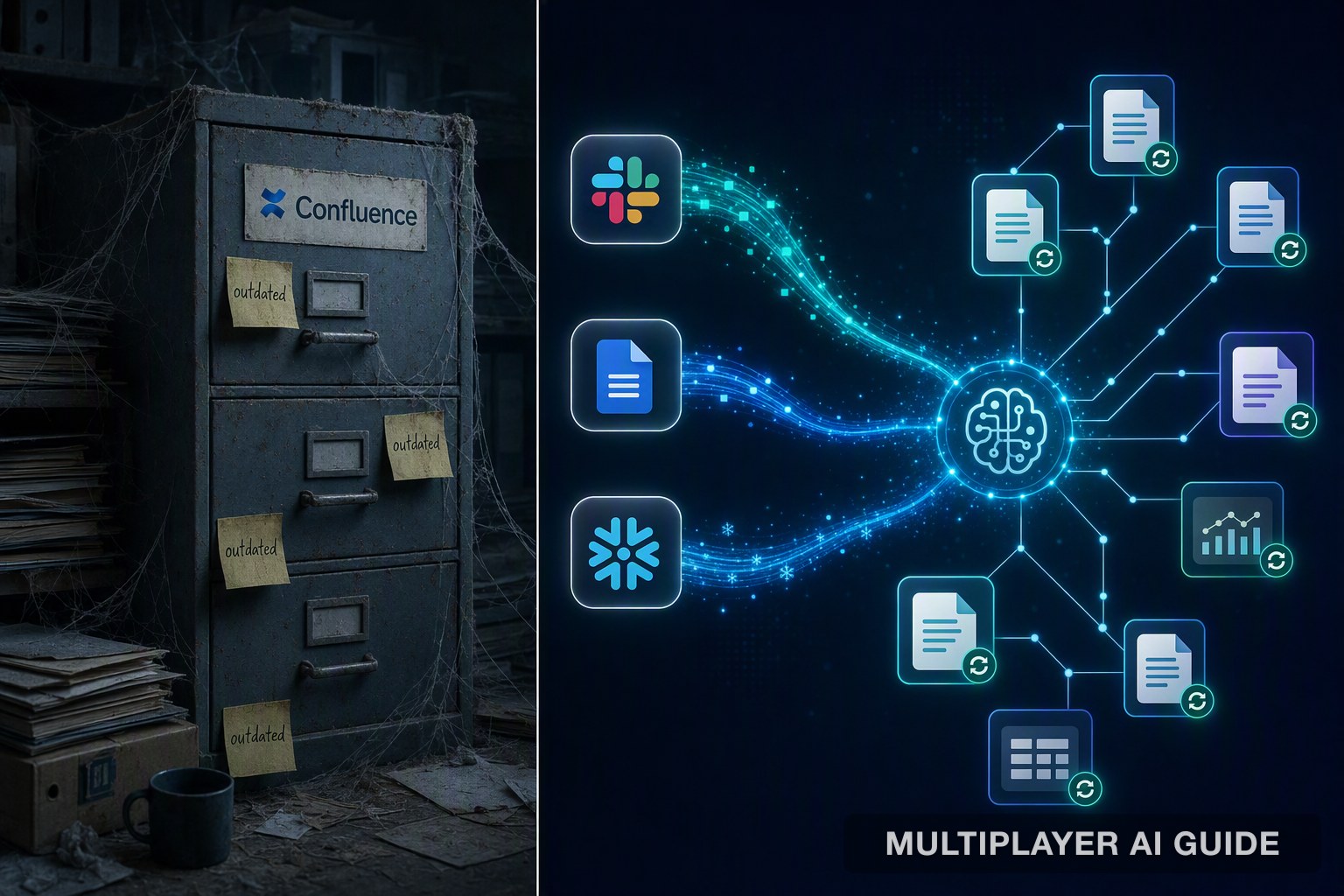
Confluence's AI layer, Atlassian Intelligence, can summarize a page and help you search faster. What it can't do is stop that page from going stale. A decision log written six months ago stays exactly as written until a human notices it's wrong and manually fixes it.
That's the real gap. Confluence treats documentation as a set of pages someone authored, not something that reflects what's actually true right now. A University of Wisconsin comparison of collaboration tools found that while Confluence provides strong search within its own structured wiki, tools like Google Workspace and Office 365 have more limited search against it, underscoring how siloed a Confluence-only setup can get once work spreads across other tools. A few signs staleness, not just formatting, is the actual problem:
- Docs quietly drift out of date, and nobody notices until someone acts on the wrong information
- The same question gets a different answer depending on which page someone happens to find
- A correction made in one place doesn't update anywhere else, so the same mistake resurfaces later
What actually makes documentation "AI-maintained"
The core distinction is simple: does a human still have to notice a page is outdated and go fix it, or does the system keep it accurate on its own, either by generating answers from live, connected data, or by letting corrections update the source of truth automatically.
A few concrete markers separate AI-maintained docs from AI-assisted ones:
- Content gets flagged or fixed automatically, not left to go stale silently
- Answers come from live, connected sources, not a static page written once
- Corrections update the source of truth permanently, not just the one conversation
- Access is enforced by permissions, so AI-maintained content doesn't surface things the wrong person shouldn't see
Key Takeaways
The bottom line for teams ready to automate their documentation stack:
- Notion agents own the file system: Custom agents can read and write PPTX, XLSX, DOCX, trigger workflows after meetings, and host external agents like Claude from a shared board.
- Agentic platforms beat static wikis: PromptQL and Notion use a semantic layer to let AI plan and execute queries across connected tools, eliminating the copy-paste errors of traditional wikis.
- Real-time collab means no account, no problem: Notion's public links require no signup, while Confluence gates public access behind an Atlassian account, crippling external sharing.
- Purpose-built tools win the edges: GitBook still rules git-synced docs; Guru surfaces verified knowledge cards in the browser; Slite keeps the remote team focused on verified truth.
- The pricing floor is real: Notion Business starts at $18/user/month with AI included. Free tiers exist, but agentic features cluster in paid plans.
4 Best Confluence alternatives for AI-maintained documentation
Tool Best for Key mechanism Limitation
PromptQL Data-grounded answers instead of authored pages Generates answers fresh from connected data each time Requires connecting real data sources, not a text editor Notion Teams that need agents to produce and update files Custom Agents read/write PPTX, XLSX, DOCX and act on a shared board Full AI access requires the Business plan Guru Surfacing verified answers in the flow of work Cards get flagged for review on a set schedule Not built for long-form document creation Slite A lighter, human-in-the-loop verification layer AI drafts and summarizes; humans mark docs reviewed and approved Verification still depends on a person, not AI
1. PromptQL
PromptQL is a multiplayer AI agent that generates answers directly from your connected data, rather than retrieving a page someone wrote earlier. Instead of documenting a decision after the fact, it queries live sources and produces the answer fresh each time it's asked.
That's a different fix than what Confluence offers. Confluence pages stay exactly as written until a human notices they're outdated and updates them. With PromptQL, a correction made once by one person updates the answer for the whole team going forward, so the same question doesn't get a stale answer the next time someone asks it.
How it keeps docs current
- Reads from connected sources like Slack, Google Docs, Snowflake, PostHog, and Salesforce CRM, using a planning prompt to query live data rather than retrieving a static page
- Corrections build a shared wiki as the system works, with revision history and a full audit trail, so a fix made once updates the answer for everyone afterward, the same underlying approach covered in how to set up a Slack AI bot that learns from corrections
Other capabilities
- Runs as single-tenant infrastructure, with enterprise plans described as offering a dedicated VPC or bring-your-own-cloud option
- Deploys in hours rather than weeks, so a team can start connecting sources without a lengthy setup project
Pricing Custom pricing.
Limitations
- Requires connecting and configuring real data sources rather than working out of the box against a demo
- Not a rich text editor, so it's not the right fit for a team whose real need is polished, narrative documentation rather than data-grounded answers
2. Notion
Notion is a workspace and wiki tool that has extended into autonomous agents capable of acting on files, not just helping someone write faster. A Notion agent can pull an update from a meeting, write it into a slide deck, and commit the revised file back to a shared drive without a person touching the export button.
Compared to Confluence, that's a meaningful jump. Confluence's AI can summarize a page for you; it can't update the spreadsheet sitting in another tab or file the follow-up itself. Notion's agents are built to act across formats, which closes part of the gap between "the AI can describe what changed" and "the AI actually changed it."
How it keeps docs current
- Custom Agents can read files you attach (PDF, CSV, XLSX, DOCX, PPTX) and create new ones, turning a page into a slide deck or a database into a spreadsheet model
- External Agents, including Claude and Cursor, can be assigned tasks from a shared board and act inside the workspace, with teammates able to see and respond to what they did
Other capabilities
- Public links can be shared with no signup required from external viewers
- Connects to external tools like Figma and GitHub, and can orchestrate other AI models like Claude and Cursor from within a shared workspace
Pricing Business plan: $20 per user per month billed annually ($24 billed monthly). Custom Agents also run on a separate usage-based credit system on top of the seat price.
Limitations
- Full agent capability is gated behind the Business plan, not available on the Free or Plus tiers
- Heavy Custom Agent usage adds variable cost beyond the flat per-seat fee
3. Guru
Guru is built around a different premise than a wiki: instead of getting someone to search for documentation, it puts a verified answer in front of them before they think to look. A browser extension and Slack integration surface knowledge cards right where people are already working.
Confluence expects someone to go find the answer inside a page tree. Guru inverts that, which matters most for teams where a rep or agent can't stop to dig through nested pages mid-call. The tradeoff is that Guru isn't trying to host long, structured documents, it's optimized for the handful of facts someone actually needs in the moment.
How it keeps docs current
- Every card has an assigned verifier and a review schedule; when a card hasn't been verified in time, the owner gets notified to confirm or update it
- AI Suggest surfaces relevant cards based on context, a Slack message, a browser URL, or a live query, rather than requiring a manual search
Other capabilities
- Integrates with Slack, Salesforce, Zendesk, and other tools reps already work in
- Browser extension surfaces cards directly inside whatever tool someone is already using, without switching tabs
Pricing Roughly $10 to $15 per user per month depending on tier.
Limitations
- Not designed for long-form document creation or a deep page hierarchy
- Verification still depends on a human confirming the card, AI flags it, but doesn't rewrite it automatically
4. Slite
Slite is a minimal, fast workspace built for remote, async-first teams who want documentation they can trust without a heavyweight structure. The AI assistant drafts and summarizes, but the feature that actually defines Slite is its verification system.
Where Confluence lets a page sit unreviewed indefinitely, Slite adds a "reviewed and approved" flag that marks a document as current. That's a lighter-weight fix than PromptQL's live data or Notion's autonomous agents, verification still depends on a person confirming the doc, but it directly addresses the specific Confluence complaint of clicking through pages only to find an abandoned draft.
How it keeps docs current
- Documents carry a reviewed and approved flag, so search surfaces the verified version instead of an outdated one
- The AI assistant can draft and summarize content, but a human marks it as current
Other capabilities
- AI "Ask" answers questions in plain English, pulling from docs as well as connected tools like Slack and Google Drive
- Fast, minimal editor with real-time collaboration built for async, remote-first teams
Pricing Roughly $8 to $12.50 per member per month depending on tier.
Limitations
- Verification is human-driven, not AI-driven, so it's a lighter mechanism than the agentic options on this list
- Less suited to teams that need AI to actually generate or update content autonomously, rather than flag it for review
How to choose the right one for you
- Want data-grounded answers instead of authored pages that can go stale: PromptQL is the realistic pick, since nothing about it is static to begin with
- Need an agent that can generate and update files like decks and spreadsheets autonomously: go with Notion
- Your bottleneck is retrieval, not authoring, and the answer needs to show up without anyone searching: go with Guru
- Want a lighter verification layer without full agentic autonomy: go with Slite
Conclusion
The right alternative depends on what "AI-maintained" needs to mean for your team. Notion gets closest to full autonomy for producing and updating files. Guru solves the retrieval half of the problem by surfacing verified answers before anyone has to search. Slite adds a lightweight, human-verified layer that's a meaningful step up from Confluence's unreviewed pages. PromptQL sidesteps the maintenance question entirely by never treating documentation as static in the first place. Pick based on whether you need AI to write, to flag, or to simply never let the answer go stale.
What are the top alternatives to Confluence for teams using AI to maintain their documentation?
The strongest options are PromptQL, for teams that want answers generated from live data instead of authored pages; Notion, for agents that can read and write files like decks and spreadsheets autonomously; and Guru, for surfacing verified knowledge cards without requiring anyone to search. The right pick depends on whether you need AI to write, to flag content for review, or to make documentation live in the first place.
How do AI-native documentation platforms compare to Confluence for automated knowledge management?
AI-native platforms use agents or live data connections to keep information current automatically. Confluence relies on Atlassian Intelligence for search and summarization, but a human still has to notice a page is outdated and manually update it, which leaves documentation stale between edit sessions.
What security and deployment features should teams look for in an AI-maintained wiki?
Look for permission enforcement that mirrors your existing access controls, so AI-maintained content never surfaces something a given person shouldn't see. Single-tenant or dedicated cloud deployment options are increasingly available for AI workloads that touch sensitive business data, worth checking for specifically if your team handles regulated or confidential information.
How does an agentic system improve documentation accuracy compared to standard wikis?
An agentic system like PromptQL plans a query and executes it against live data, so an answer reflects the current state of the source system rather than a page written and never revisited. That's a structural difference from a standard wiki, where accuracy depends entirely on someone remembering to go back and edit the page.
Which AI wiki solutions support real-time collaboration with shared public links and no signup requirements?
Notion allows public links to be shared with no signup required from external viewers. PromptQL is built around shared, multiplayer threads, though the specific sharing mechanics are worth confirming directly for your use case. Confluence, by contrast, gates public access behind an Atlassian account, which limits how easily external partners can view shared content.
Frequently Asked Questions
::: faq-item
What are the top alternatives to Confluence for teams using AI to maintain their documentation?
:::
Sources
- PromptQL | Multiplayer AI with shared context. - promptql.io
- Comparison of Confluence Alternatives - kb.wisc.edu
- What's New in Notion - www.notion.com
Last verified: 2026-08-11